Its revenue is metered, not subscribed. Snowflake tells the SEC it delivers its platform through a "customer-centric, consumption-based business model," and books revenue "as customers consume compute, storage, and data transfer resources" — so a signed contract and a recognised dollar sit further apart here than at a vendor selling seats. This profile covers what the company sells, why that meter decides which disclosure matters, and what separates the NYSE-listed share from the Ondo token on Bitbase and from the stablecoin-margined perpetual.
What Is Snowflake (SNOW)?
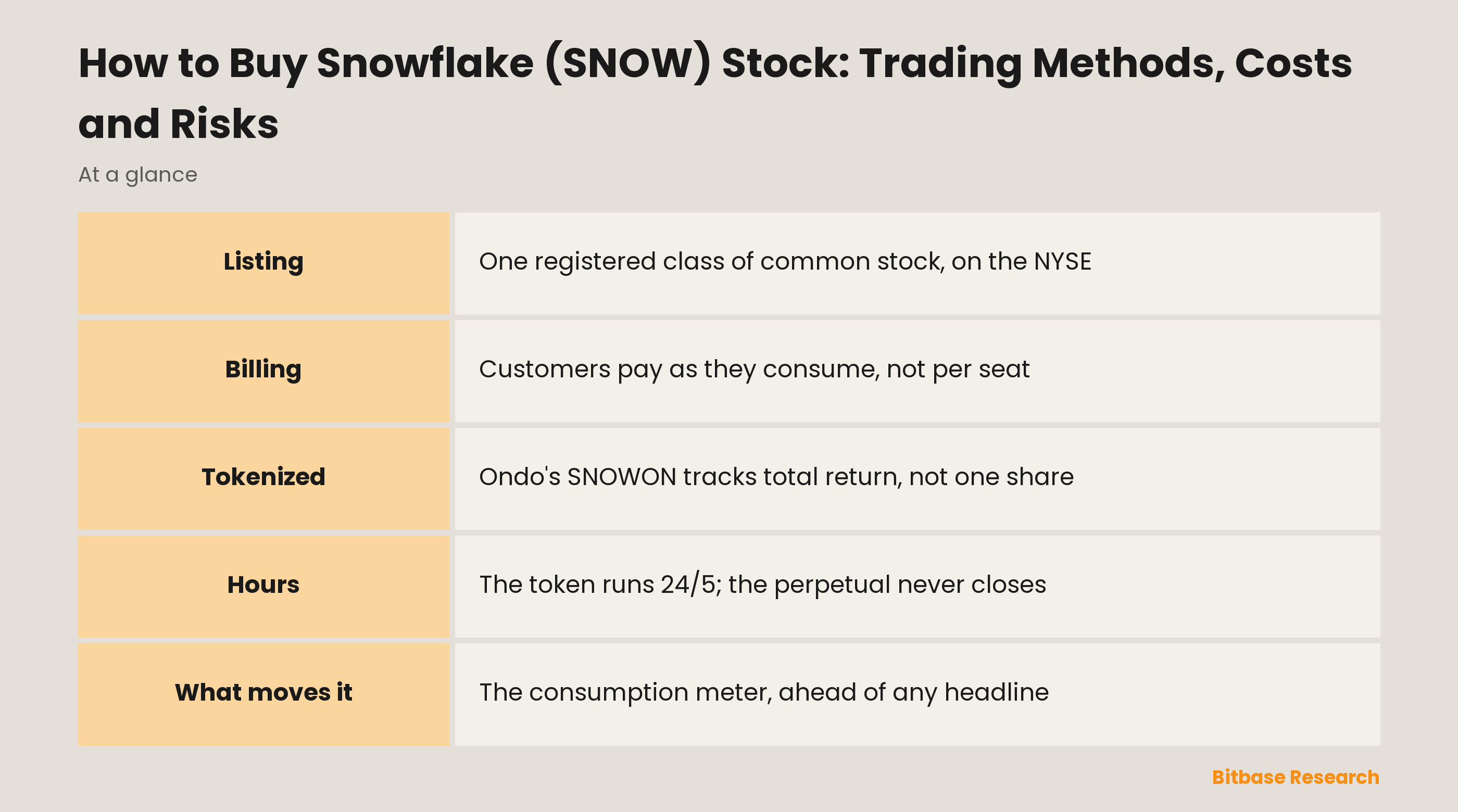
Delaware is where Snowflake Inc. is incorporated, and the cover of its annual report registers exactly one security under Section 12(b): common stock, trading as SNOW on the New York Stock Exchange. Much of the software cohort this ticker gets grouped with lists on Nasdaq instead.
The company calls its platform "the innovative technology that powers the AI Data Cloud, enabling customers to consolidate data into a single source of truth." One clause nearby outweighs all of that for anyone pricing the equity: "We provide our platform through a customer-centric, consumption-based business model."
The reporting calendar belongs to nobody else. The fiscal year closes on 31 January, so the report labelled fiscal 2026 covers a period ending 31 January 2026 — never the same stretch of time as a December year-end peer.
A last cover detail repays attention. The fiscal 2024 and fiscal 2025 reports register "Class A Common Stock"; the fiscal 2026 report registers "Common Stock", with symbol and exchange identical across all three. The class label came off the registered security somewhere between those filings — invisible on a price chart, plain on a cover page.
Why People Trade SNOW
A position in SNOW is a position on usage, and the filings are explicit about the plumbing. Customers "choose to consume the platform under either capacity arrangements, in which customers commit to a certain amount of consumption at specified prices, or under on-demand arrangements." Under capacity arrangements, "from which a majority of revenue is derived, the Company typically bills its customers annually in advance."
Those two sentences open a gap a seat-priced vendor never has. Cash arrives at the start of a term; revenue arrives only as the platform gets used. Between them sits a commitment the customer may not spend, and the contracts often forgive that: "In many cases, customer contracts permit customers to roll over any unused capacity to a subsequent order, generally on the purchase of additional capacity."
The meter itself is granular, and each dial is spelled out. "For compute resources, consumption is based on the type of compute resource used and the duration of use or, for some features, the volume of data processed." Storage rests on "the average terabytes per month," data transfer on "terabytes of data transferred, the public cloud provider used, and the region."
That granularity cuts both ways: a workload moved onto the platform raises the bill with no contract renegotiated, and a query rewritten to scan less data lowers it the same silent way.
A Share, a Total-Return Tracker, and a Funding Payment
On Bitbase this ticker resolves to a page titled Snowflake (Ondo Tokenized Stock) (SNOWON), and the issuer named there decides what the instrument is.
Ondo's documentation refuses the obvious shorthand: "One token does not necessarily represent the value of one share, and the price of one token will not always match the price of the underlying asset." What it tracks is total return, with dividends going back into the token's value after withholding tax rather than reaching a holder as cash. Nor do rights travel with it — holders "do not receive shareholder voting rights, statutory information rights or other shareholder rights" — and availability is generally limited to non-US investors, subject to jurisdictional and other restrictions. Trading runs 24/5 rather than around the clock, pausing for corporate actions and risk controls, with a small set of assets quotable in an Off-Hours window. Minting and burning are instant, and a purchase or sale exchanges tokens for stablecoins "in a single atomic transaction."
The perpetual belongs to a third category. Nothing sits behind it — not a share, not a token, not a custodian — it never expires, margin and settlement are in stablecoin, and funding moves at intervals from the crowded side of the book to the other.
What a stock perpetual adds to familiar crypto machinery is a reference market that shuts. How the mark behaves while the underlying is dark, and what becomes of funding then, are answers held by the venue's contract rules page.
How to Trade SNOW on Bitbase
The price page is where to look first, because its heading carries the issuer's name beside the quote, and the wider lineup of equity-linked instruments shows which symbols come with which routes.
The tradeable route here is the perpetual contract. Margin goes up in stablecoin, size is expressed in contracts instead of shares, and nothing expires that would have to be rolled. The phrase that brings most people here — buy SNOW stock with USDT — names the funding currency accurately and the object of purchase not at all: a stablecoin buys a contract referencing a price.
A sale here opens a short rather than trimming an inventory, which is what anyone asking how to short SNOW stock is really after: no borrow to locate, no recall to fear.
The two costs have different shapes: spread and fee land twice, at entry and exit, then finish, while funding repeats for every interval the position survives, so the length of the hold prices the trade as surely as the entry does. Survival is a question about the buffer, since margin requirements fix how far the mark can move before the venue closes you out and the arithmetic behind a liquidation price belongs to the sizing decision. Interval, formula and caps are contract parameters — take them from the rules page of the platform you trade on.
Away from the venue, the NYSE line is an ordinary brokerage purchase that trades only while that exchange is open.
What Moves SNOW
Start with the sentence the company sets beside its own forward book: "the amount and timing of revenue recognition are generally dependent upon customers' future consumption, which is inherently variable at customers' discretion and can extend beyond the original contract term in cases where customers are permitted to roll over unused capacity to future periods, generally on the purchase of additional capacity at renewal."
Every clause carries weight. Timing is uncertain as well as amount. The variability belongs to the customer. And an obligation can outlive the contract that created it.
That is why the forward book gets read closely, and why its wording tells you more than its size. "Remaining performance obligations (RPO) represent the amount of contracted future revenue that has not yet been recognized, including (i) deferred revenue and (ii) non-cancelable contracted amounts that will be invoiced and recognized as revenue in future periods." A growing figure says customers have promised to pay, not when they will consume — and the company has already said it cannot say either.
What the measure excludes matters as much: "The Company's RPO excludes performance obligations from on-demand arrangements as there are no minimum purchase commitments associated with these arrangements." Whatever the pay-as-you-go portion is doing stays invisible in the forward book by construction.
The meter also makes efficiency a revenue variable in a way seat pricing never does. Since consumption is measured by compute type and duration, by terabytes stored and by terabytes moved, a customer that tunes its warehouses spends less without cancelling anything — and neither direction gets announced.
Risks and Limits
The token puts an issuer between holder and company. Its value depends on Ondo's structure, eligibility rules and redemption terms, all of which the issuer can change, and it is explicitly not a claim on one share.
Three clocks run over one exposure: an exchange session, a token trading 24/5 with issuer pauses, and a contract with no closing bell. News landing while two of them are shut is priced by whichever venue is open, and the others catch up in a single print.
Leverage turns that gap into an exit. Closure follows the mark, not whatever printed last, and funding stays owed in either direction. A size that sits comfortably through an ordinary session can be ended by a weekend move a shareholder would have slept through.
No wrapper touches the meter. Customers consuming less than they committed reaches the registered share, Ondo's token and the contract alike, and the rollover language means an unspent commitment can resurface rather than disappear.
One limit belongs to this article: the company's own risk factors have a section of the annual report to themselves, and they are not condensed here.
How to Verify SNOW Information
Everything quoted above sits on SEC EDGAR under CIK 1640147, in filings carrying file number 001-39504. One detail decides whether the right document appears: with a fiscal year ending 31 January, the report to open is the one whose period closes in January, and a search set to a calendar year-end returns the wrong year or nothing.
Read the cover page before the prose. Legal name, state of incorporation, registered security title, symbol and exchange all sit there, filled in field by field rather than written as sentences, which makes it the place to settle a question such as how many classes are registered. Comparing two years of covers is how the change described earlier becomes visible.
| What to read | Where it lives | What it settles |
|---|---|---|
| The cover page | First page of the annual report | Name, incorporation, security title, symbol, exchange |
| The revenue recognition policy | Notes to the accounts | Capacity or on demand, and when consumption becomes revenue |
| The remaining performance obligations note | The revenue note | What is contracted but unrecognised, and what it omits |
| The contract rules page | Venue derivatives documentation | Funding interval, margin tiers, closure mechanics |
On the venue side, the issuer's name in the instrument heading answers what a symbol cannot; a heading naming nobody is not describing a tokenized equity. Ondo's own documentation is where backing, rights and calendar are authoritative.
Conclusion
Buying SNOW is a choice between an owner's claim and two contracts about a price. Shareholder status attaches to one route only, the common stock listed on the NYSE. Ondo's token tracks total return while conferring no shareholder right, on the issuer's calendar. The perpetual owns nothing and bills funding for every interval the position stays open.
Underneath all three sits a meter. Snowflake gets paid when data is queried, stored and moved, not when a seat is filled, so the first disclosure to read is not the revenue line but the consumption language around it: capacity against on demand, the rollover of unused capacity, and a forward book that depends on consumption "inherently variable at customers' discretion."
Related reading
Other Bitbase articles on this topic:
- How to Buy ETHA: Fees, Trading Hours and Differences from Ethereum
- How to Buy IBIT: Fees, Trading Hours and Differences from Bitcoin
- How to Buy Intercontinental Exchange (ICE) Stock: Trading Methods, Costs and Risks
- How to Trade Stocks on Bitbase: A Step-by-Step Guide for Crypto Traders
- How to Read Crypto ETF Flows
Disclaimer: This article is educational content from Bitbase Academy, provided for information only. It explains what a company or fund does and how the instruments referenced here differ from one another; it does not constitute investment, trading, tax, or financial advice, and it is neither a recommendation nor an endorsement of any security, token, or trading strategy. A tokenized stock is issued by a third party and is designed to give economic exposure to an underlying asset: it is not a share, it carries no shareholder rights, and it depends on the issuer's structure, eligibility rules, and redemption terms, which the issuer can change. Perpetual futures are leveraged derivatives that hold no underlying asset and can be liquidated, and trading hours, product availability, and eligibility differ by instrument and by jurisdiction and can change at any time. Written as of September 2026; verify everything yourself through company filings, the issuer's own documentation, and the product pages of the venue you trade on.
References
[1] Snowflake FY2026 Form 10-K: business model, revenue recognition and remaining performance obligations (SEC EDGAR) www.sec.gov
[2] Structured cover page of the same filing: registrant, incorporation, registered security, symbol, exchange and fiscal year www.sec.gov
[3] Ondo Stocks overview: backing, rights and trading hours (Ondo official documentation) docs.ondo.finance