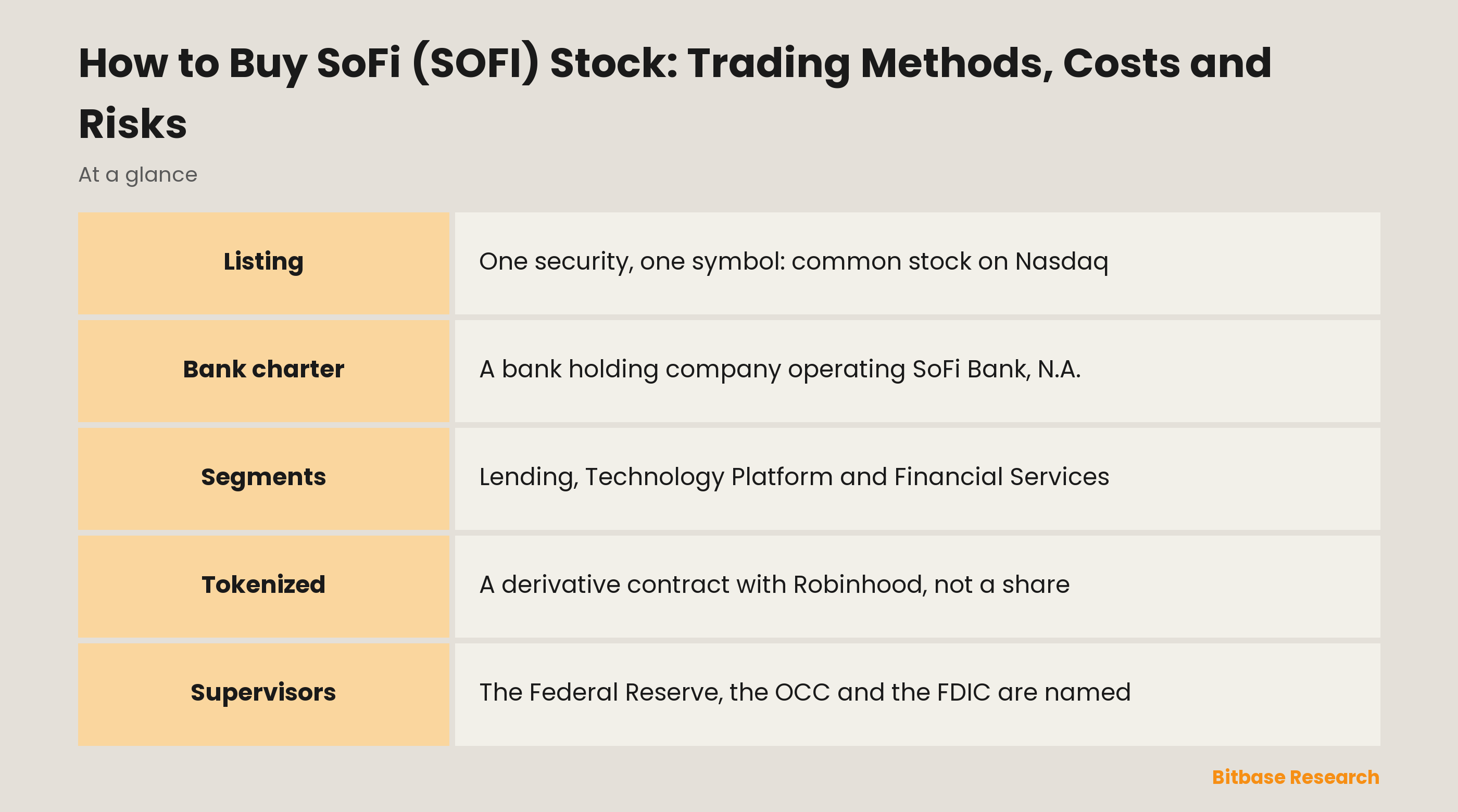
Unlike the payment processors and software firms it is shelved beside, SoFi Technologies owns a bank, and that changes who its annual report answers to. The structured cover of that report registers exactly one security under exactly one trading symbol, and the charter behind it gives a holder of voting common stock one vote per share. What carries those four letters on Bitbase is not that share: it is a derivative contract written in Europe by Robinhood, quoted beside a perpetual that holds nothing at all.
What Is SoFi Technologies (SOFI)?
SoFi states its starting point in one line: "SoFi is a financial services platform that was founded in 2011 to offer an innovative approach to the private student loan market by providing student loan refinancing options." It did not stay there. The annual report states that "the Company conducts its business through three reportable segments: Lending, Technology Platform and Financial Services."
The oldest of the three is bounded tightly: "the Lending segment includes our personal loan, student loan and home loan products and the related servicing activities." Servicing sits in the same segment as origination, so the work outlasts the writing of the loan.
Technology Platform sells to institutions rather than to consumers. Its revenue is "related to our integrated technology platform as a service through Galileo, which provides the infrastructure to facilitate core client-facing and back-end capabilities, such as account setup, account funding, direct deposit." Technisys added "a cloud-native digital and core banking platform offering," sold as "software licenses and associated services, including implementation and maintenance." Other companies run accounts on this, and their users never see the name.
Financial Services holds the consumer products that are not loans: "our SoFi Money product, primarily inclusive of checking and savings accounts," the "SoFi Invest product which provides investment features and financial planning services," and "SoFi Credit Card products," alongside a Loan Platform Business.
One sentence separates this filing from the other fintech annual reports. "During 2022, the Company became a bank holding company and began operating as SoFi Bank, National Association, through its acquisition of Golden Pacific Bancorp, Inc." That is a change of legal category, and the deposits note shows what it brought: "we offer deposit accounts (referred to as 'checking and savings' accounts within SoFi Money) to our members through SoFi Bank, which include interest-bearing deposits and noninterest-bearing deposits."
The cover supplies the identifiers. SoFi Technologies, Inc. is a Delaware corporation whose fiscal year ends on 31 December, and whose common stock is listed on Nasdaq under SOFI.
Why People Trade SOFI
A lender that holds deposits is a different animal from one that does not: the money it lends and the money it owes sit under one roof and reprice on separate schedules. That is why this filing borrows its vocabulary from banking rather than from software.
The regulatory capital note sets the arrangement out plainly: "SoFi Technologies, a bank holding company, and SoFi Bank, a nationally chartered association, are required to comply with regulatory capital rules issued by the Federal Reserve and other U.S. banking regulators, including the OCC and FDIC." Three supervisors in one sentence, and the company must "manage our capital position to maintain sufficient capital to satisfy these regulatory rules and support our business activities."
The segments give three clocks under one listing. Loans answer to borrowers repaying. Galileo and Technisys answer to client institutions signing and implementing. SoFi Money, SoFi Invest and the card answer to how members use accounts they already hold.
Traders arriving from crypto look for the segment that would explain a correlation, and the names answer that: Lending, Technology Platform, Financial Services. None of the three is named for digital assets. For readers who reach listed companies through stablecoins rather than a brokerage account, the route in is the crypto part; the filing underneath is a bank's.
Three Claims, Three Rulebooks
The Bitbase market page for these letters is titled SoFi Technologies (Robinhood Tokenized Stock) (SOFI). Read the issuer name before the chart: the issuer, not the ticker, decides what the instrument is.
Robinhood defines its product in words narrower than the label suggests. Classic Stock Tokens "are derivative contracts between you and Robinhood," and "they are priced at the prices of the underlying securities without granting rights to them." The shares exist and Robinhood keeps them: "the underlying assets of Classic Stock Tokens are owned by Robinhood and held with a US-licensed institution." The claim runs against the issuer, not against SoFi, since the tokens "do not grant any rights to the underlying shares or ETPs." Trading runs from Monday at 02:00 CET until Saturday at 02:00 CET, under Robinhood Europe, UAB, an entity supervised by the Bank of Lithuania.
A perpetual futures contract is a claim of a third kind, with nothing held behind it. It references the quoted price, settles in stablecoin, moves a periodic funding payment between the two sides of the book, and can be closed by the venue when margin runs thin. Its terms live in exchange rules, a different sort of document from a charter or a banking licence.
Each route answers to a rulebook of its own, and none governs the other two. The charter authorises voting common stock, non-voting common stock and preferred stock, while the structured cover registers one security with one symbol, and "each holder of SoFi Technologies voting common stock is entitled to one vote per share on each matter submitted to a vote of stockholders." The token is a claim under Lithuanian-supervised terms stating in writing that it confers no rights in the shares; the perpetual is a claim under exchange rules promising no asset at all.
Capital rules can restrict what the company does, issuer terms can restrict what the token does, and the third route has none to restrict because nobody holds anything for it. How such wrappers are arranged in general sits with the tokenized listings themselves.
Where SOFI Trades on Bitbase
The price page is the reference surface: quote, chart and market data, with the issuer named in the instrument title. It costs nothing to open and settles the identity question before any order is considered.
The perpetual contract is what can actually be traded here. Collateral is stablecoin, closure is decided against a mark rather than whatever printed last, and funding moves at intervals from the heavier side of the book to the lighter one. A position carried across weeks meets that transfer repeatedly, so it belongs in the sum before entry. Selling this contract opens a short, which is a different act from trimming something owned. The intervals, the formula and the margin tiers are published on the venue's contract specification page and nowhere else.
Away from the venue, a broker with access to Nasdaq reaches the listed stock itself — the only route that ends with a name on a share register.
What Moves SOFI
Deposits and loans are one conversation seen from opposite ends, and both reprice with rates. The deposits note names interest-bearing and noninterest-bearing accounts held by members through SoFi Bank; the Lending segment names personal, student and home loans plus servicing. When the cost of one moves and the yield on the other does not follow, the gap reaches results without a headline.
Credit performance is a separate conversation. A loan book is exposure to repayment, and repayment answers to employment and to household balance sheets rather than to anything SoFi announces.
Technology Platform runs on a calendar of its own, because Galileo and Technisys revenue arrives from client institutions that sign, implement and maintain, and implementation is measured in quarters.
Above all of them sits permission, which has no equivalent in a software filing. The company writes that "if the Federal Reserve finds that we are not 'well-capitalized' or 'well-managed', we would be required to take remedial action, which may contain additional limitations or conditions relating to our activities," and that "the Federal Reserve and the OCC have authority to require banking organizations subject to their supervision to hold additional amounts of capital in excess of the minimum risk-based capital ratios." A supervisor can demand more capital and attach conditions to what the business may do — a constraint on the enterprise rather than on its quote, reaching all three routes alike.
Risks and Limits
Counterparty structure is the risk only the token route carries. What is held is an obligation of Robinhood Europe, UAB, worth whatever that firm remains able and willing to perform under its published terms. Naming a central bank as supervisor identifies who inspects the issuer; it warrants nothing about the instrument.
Three schedules cover one price and none matches the others: an exchange session, a window shutting at 02:00 CET on Saturday, and a contract with no closing bell. What happens while the stock market is dark gets priced by whatever still trades, so the gap at the reopen is ordinary rather than exceptional.
Leverage compounds that gap. A perpetual is closed against a mark price that need not match any trade its holder saw, and funding accrues whichever way the crowd leans.
The bank underneath reaches every route unchanged. Rate moves, credit performance, platform implementations and supervisory conditions belong to the company, not to the wrapper. A wrapper decides your rights and your settlement; the exposure was decided before you chose one.
What to Open on EDGAR, and in What Order
Start with the structured cover report rather than the prose cover. Each annual report on EDGAR is published alongside a machine-filled cover page listing the registrant name, the state of incorporation, the title of every security registered under Section 12(b), the trading symbol, the exchange and the fiscal year. Counting distinct symbols there beats reading a paragraph about them, and here the count is one.
Then open the Organization note, which carries the segment sentence and the bank holding company sentence quoted above, and the Regulatory Capital note, which names the Federal Reserve, the OCC and the FDIC. SoFi files under CIK 1818874, and both notes are rendered as pages of their own inside the filing.
For the wrapper, Robinhood's European product pages state the contract definition, the ownership of the underlying, the absence of rights and the trading window. Anything about Classic Stock Tokens absent from those pages is unverified rather than implied.
For the venue, read the market page title before the chart, then the contract specification page for any figure about funding or margin.
Conclusion
Buying SOFI starts with a question the ticker hides: which claim. The exchange answer is a Delaware company's common stock, one security under one symbol, one vote per share, above a chartered bank supervised by the Federal Reserve, the OCC and the FDIC. The Bitbase answer is an obligation of Robinhood Europe, UAB, priced off that share while conferring nothing in it. The leveraged answer holds no asset and bills by the interval for direction.
The same lender sits under all three. Read the segment names, the deposits note and the capital language before anything written about the ticker.
Related reading
Other Bitbase articles on this topic:
- How to Buy IBIT: Fees, Trading Hours and Differences from Bitcoin
- How to Buy Intercontinental Exchange (ICE) Stock: Trading Methods, Costs and Risks
- How to Buy Eli Lilly (LLY) Stock: Trading Methods, Costs and Risks
- How to Buy TSLA: Two Segments, Three Instruments
- Curve Finance Explained
Disclaimer: This article is educational content from Bitbase Academy, provided for information only. It explains what a company or fund does and how the instruments referenced here differ from one another; it does not constitute investment, trading, tax, or financial advice, and it is neither a recommendation nor an endorsement of any security, token, or trading strategy. A tokenized stock is issued by a third party and is designed to give economic exposure to an underlying asset: it is not a share, it carries no shareholder rights, and it depends on the issuer's structure, eligibility rules, and redemption terms, which the issuer can change. Perpetual futures are leveraged derivatives that hold no underlying asset and can be liquidated, and trading hours, product availability, and eligibility differ by instrument and by jurisdiction and can change at any time. Written as of September 2026; verify everything yourself through company filings, the issuer's own documentation, and the product pages of the venue you trade on.
References
[1] SoFi Technologies FY2025 Form 10-K: segments, bank holding company status, deposits and regulatory capital (SEC EDGAR) www.sec.gov
[2] Structured XBRL cover page of that filing: registrant, incorporation, 12(b) security, symbol, exchange and fiscal year www.sec.gov
[3] Robinhood Europe: what Classic Stock Tokens are, who holds the underlying, rights and trading window robinhood.com