ProShares built SQQQ around a single trading day. It seeks daily investment results, before fees and expenses, that correspond to three times the inverse (-3x) of the daily performance of the Nasdaq-100 Index, and the prospectus adds that it does not seek that result for any period other than a day. Most of the confusion around this ticker follows from that sentence: what the fund holds, why a week of chop can cost a holder who called the direction right, and why its costs look nothing like borrowing QQQ shares to sell them.
What Is ProShares UltraPro Short QQQ (SQQQ)?
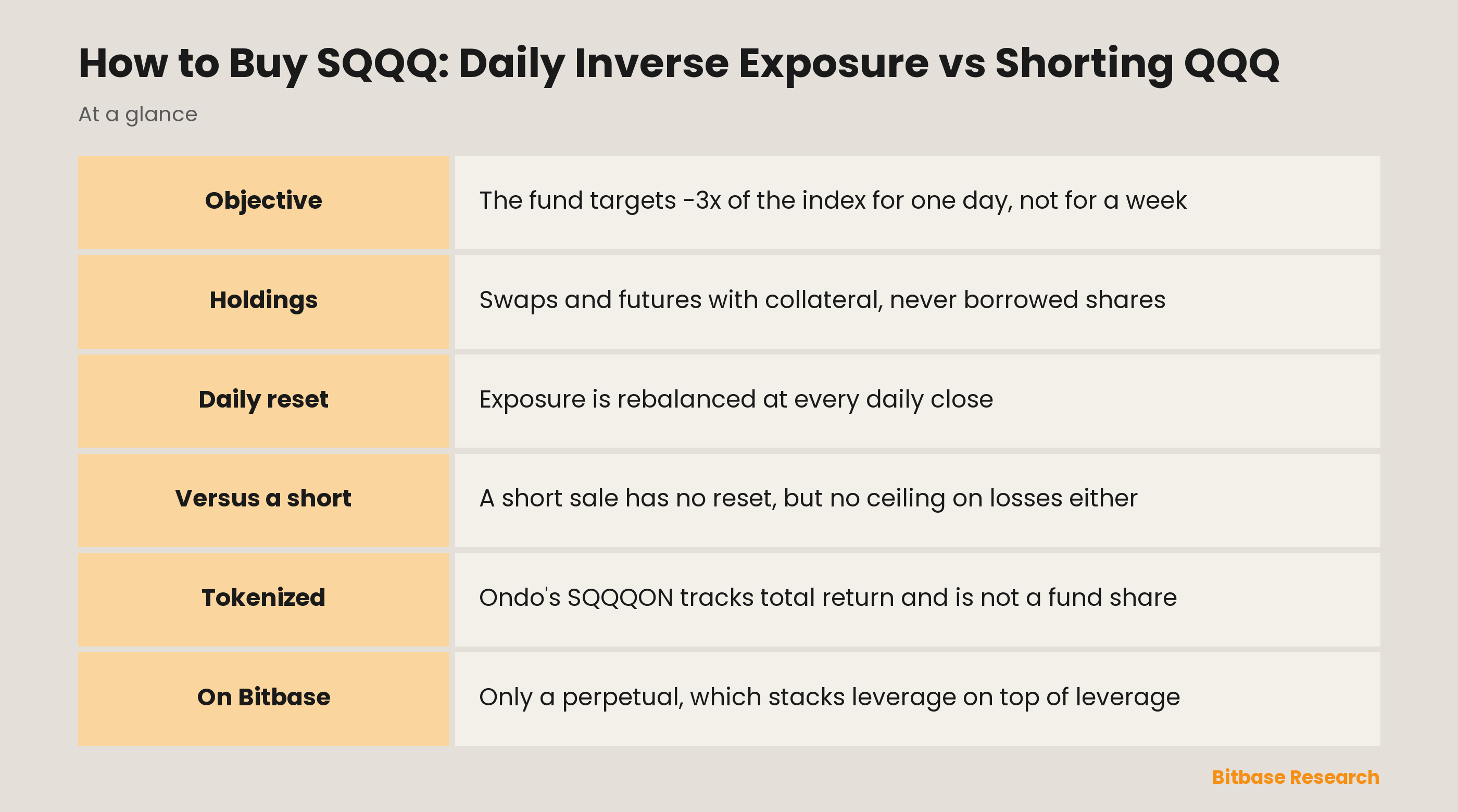
SQQQ is an exchange-traded fund listed on The Nasdaq Stock Market and running since 2010. Its stated objective is to "seek daily investment results, before fees and expenses, that correspond to three times the inverse (-3x) of the daily performance of the Nasdaq-100 Index."
Read the object of that sentence closely: it names the index, not the fund that tracks it. The prospectus describes the Nasdaq-100 as measuring 100 of the largest Nasdaq-listed non-financial companies, maintained by Nasdaq Inc. QQQ follows the same index from the long side, and the QQQ profile sets out the rules that drive both.
The fund does not borrow shares and sell them. Its prospectus describes a portfolio of financial instruments, principally swap agreements and futures contracts, held "in order to gain inverse leveraged exposure to the Index", with money market instruments as collateral. A shareholder owns a slice of a derivatives book, not a short position in any company.
Then the mechanism that does the damage later: "The Fund seeks to rebalance its portfolio each day so that its exposure to the Index is consistent with the Daily Target." A fall in the index raises net assets and exposure has to go up; a rise cuts it. The adjustment is not discretionary — it is how a daily objective gets met.
Why People Trade SQQQ
Access comes first. A bearish position on the Nasdaq-100 through a broker normally needs a margin account, a located stock loan and an open-ended liability; SQQQ turns it into an ordinary buy order where the most that can be lost is the amount paid. What it costs instead is the fund's published expenses plus whatever daily rebalancing does to the return over the holding period — no margin call, no borrow fee, no expiry, but the prospectus names the cost of obtaining short exposure and the cost of obtaining leverage as separate drags on returns.
Borrowing QQQ shares prices the same view differently: a stock-loan fee that moves with how hard they are to borrow, plus interest on the financed part. There is no daily reset and no compounding, so this route follows a multi-week view more cleanly, but the loss is open-ended, because the shares have to be returned at whatever they cost by then.
A perpetual contract prices it by time. It holds nothing, never expires, and transfers funding periodically between the two sides of the book, in whichever direction the crowd sits. Cost accrues with duration rather than with distance travelled.
Hours divide the three as sharply as cost does, and what matters is where the day ends, not how long the session runs. The fund resets at its daily close, the Ondo token trades on a 24/5 schedule set by its issuer, and the contract does not close. Carry a fund position through the close and you own a slightly different instrument the next morning, rebuilt from whatever the rebalance produced.
What the Token and the Contract Sit On Top Of
Two issuers are in play, and merging them is the standard mistake. ProShares issues the fund and sets its objective, portfolio and fees. The tokenized version is issued by Ondo: the Bitbase price page names it ProShares UltraPro Short QQQ (Ondo Tokenized), trading under the symbol SQQQON. Neither issuer's terms bind the other.
Ondo's structure is neither a fund share nor a claim on one. The tokens are total return trackers rather than one-for-one representations — one token does not necessarily represent the value of one share, and the price of one token will not always match the price of the underlying asset. Holders receive no shareholder voting rights, no statutory information rights and no other shareholder rights, and trading generally runs 24/5 rather than continuously.
The contract is a third object, and here the stacking matters. It references the price of SQQQ, and SQQQ already carries a -3x daily objective, so leverage taken on the contract multiplies the fund's leverage rather than replacing it. Size it as though the reference were an ordinary index fund and it is sized wrong by a wide margin.
How to Trade SQQQ on Bitbase
One route exists on Bitbase for this ticker: the perpetual contract. Margin is posted in stablecoin, the position is valued off an index rather than off the last print, and funding moves in or out of the account each period according to which side of the book is crowded. Because it never expires, the question it forces is how long to hold, not when to roll.
Two parameters deserve a look on the contract rules page first, and neither can be assumed from familiarity with crypto perpetuals: the funding interval and formula, including any caps, and the margin schedule for this specific contract. Both are set by the venue and both can change. The wider set of tokenized equity markets and stock perpetuals sits on the Bitbase TradFi hub.
What Moves SQQQ
The index's daily move is the obvious input, inverted and multiplied, and it explains a single session almost completely. Across any longer window it explains much less, because volatility acts on the fund directly rather than through direction. Exposure resets every day, so a holding-period return is each day's result compounded, and compounding inverted, tripled moves is not the same operation as inverting and tripling the whole period's move. ProShares puts it in its own risk language: index volatility has a negative impact on fund returns, and in periods of higher index volatility it may affect returns as much as or more than the index's own return. A Nasdaq-100 that ends a month lower after a violent path can still leave a holder of this fund behind.
Financing runs underneath. Exposure is manufactured with swaps and futures whose financing costs the prospectus names among the factors that will adversely impact the fund's ability to meet its daily target. Alongside them sits the rest of what it calls correlation risk — fees, transaction costs, counterparty performance, and the possibility that the fund cannot rebalance all of its investments and ends the day significantly away from the daily target. None of it is a market view, and all of it reaches the price.
Risks and Limits
The leverage limit is stated, not theoretical. ProShares writes that if the index approaches a 33% gain at any point in the day, you could lose your entire investment. That is not a caution about long holding periods; it describes what three times inverse exposure means on one very bad day.
A flat market is not a neutral one either. The fund can lose money when the index goes nowhere over time, because rebalancing and volatility act on the position regardless of where the index finishes.
Issuer risk is stacked rather than shared. The token depends on Ondo staying in business and standing behind redemption on the terms it publishes, the fund depends on its swap counterparties, and the contract depends on venue rules the venue can revise. And because the three calendars do not line up, whatever lands outside the equity session gets priced by whichever venue is still open.
How to Verify SQQQ Information
Start with the fund rather than commentary about it. ProShares publishes the SQQQ fund page and the summary prospectus, and the objective, the rebalancing description and the risk language quoted above all come from the prospectus. The fee table sits in the same document under "Annual Fund Operating Expenses", where the expense ratio appears as Total Annual Fund Operating Expenses both before and after fee waivers — read both rows and the footnote, because the waiver carries an expiry date and the two figures differ.
For the index, go to Nasdaq's own methodology rather than summaries of it; membership and weighting changes are announced there ahead of their effective dates and reach this fund without anyone at ProShares deciding anything. For the tokenized version, only Ondo's own documentation settles backing, rights and hours. For the market, the Bitbase price page confirms the instrument name and symbol, and the contract rules page carries the funding and margin parameters.
Conclusion
SQQQ has a narrow design brief: one day of inverse, tripled exposure to the Nasdaq-100, manufactured with swaps and reset every session. Inside that window it does what the prospectus says. Outside it, the position compounds, and the outcome depends on the path the index took rather than only on where it ended.
Against borrowing QQQ shares, it swaps an open-ended liability for a bounded one and pays for that bound with rebalancing drag. Against a contract written on its own price, it is the thing referenced rather than the thing traded. Work out which of the three you are taking before the order goes in.
Related reading
Other Bitbase articles on this topic:
- How to Buy IBIT: Fees, Trading Hours and Differences from Bitcoin
- How to Buy Intercontinental Exchange (ICE) Stock: Trading Methods, Costs and Risks
- How to Buy Eli Lilly (LLY) Stock: Trading Methods, Costs and Risks
- How to Trade UBER: What Uber Keeps From Every Trip
- What Is Recall Network? AI Skill Markets and RECALL
Disclaimer: This article is educational content from Bitbase Academy, provided for information only. It explains what a company or fund does and how the instruments referenced here differ from one another; it does not constitute investment, trading, tax, or financial advice, and it is neither a recommendation nor an endorsement of any security, token, or trading strategy. A tokenized stock is issued by a third party and is designed to give economic exposure to an underlying asset: it is not a share, it carries no shareholder rights, and it depends on the issuer's structure, eligibility rules, and redemption terms, which the issuer can change. Perpetual futures are leveraged derivatives that hold no underlying asset and can be liquidated, and trading hours, product availability, and eligibility differ by instrument and by jurisdiction and can change at any time. Written as of September 2026; verify everything yourself through company filings, the issuer's own documentation, and the product pages of the venue you trade on.
References
[1] ProShares UltraPro Short QQQ summary prospectus: objective, strategies and principal risks www.proshares.com
[2] ProShares SQQQ fund page: fund documents, holdings and expense ratio www.proshares.com
[3] Ondo Stocks overview: backing, rights and trading hours docs.ondo.finance