Before a tokenized stock order can fill, three things have been settled somewhere you did not look: which stablecoin sits on the other side of the pair, which issuer wrote the token, and what the smallest unit you can buy is a unit of. None of them shows up in the symbol, and each changes what the position costs and what it gives you. This piece follows one order from the quote asset to the exit, including the case the phrase quietly covers: a tokenized ETF, where one wrapper sits on another.
Which stablecoin is on the other side
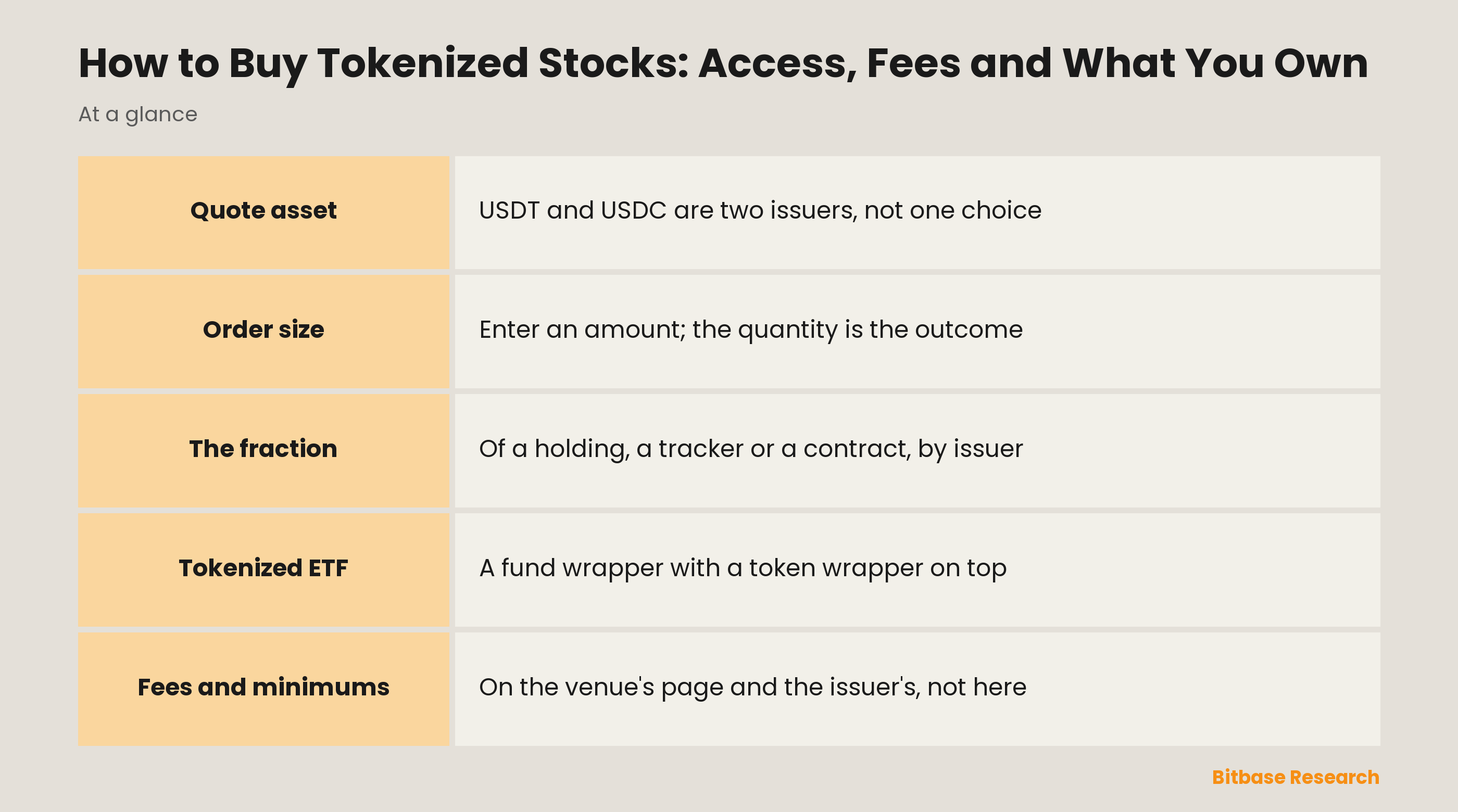
A tokenized stock trades as a pair, and the side you pay with is an asset in its own right. USDT and USDC are both built to hold their value against the dollar, but they come from different issuers under different reserve arrangements; how the two largest stablecoins compare sets out where they part company. Which one a book is quoted in belongs to that book, not to the stock.
Two things follow. If your balance is in one and the market you want is quoted in the other, the first leg is a conversion, with its own spread and fee, charged before any equity exposure exists. And a quote is a ratio between two assets, so the tokenized stock is one issuer's structure priced in another issuer's liability.
Whether to buy the token at all, rather than take the exposure through a stock perpetual, is what two routes from a stablecoin balance works through; that comparison lives there. Everything below assumes the decision went the token way, and asks what the order involves.
Ordering by amount rather than by share count
On a brokerage the unit is a share, and buying part of one is a programme the broker had to build. On a token market the unit is a token, and divisibility is in the format: the balance carries decimal places, so an order is a quantity with a point in it before anyone decides to permit fractions. What gets sold elsewhere as fractional access is, on this rail, what the format already was.
That changes what a fill tells you. Entering an amount is as natural as entering a count, and an order placed by amount resolves into whatever quantity the book returns at the prices available. The quantity becomes an outcome rather than an instruction, and the price you read afterwards is an average of the fills.
What a fraction is actually a fraction of
Divisibility answers how small. It does not answer of what, and that answer comes from the issuer rather than from the decimal. The four answer it differently; the comparison sits under what the symbol tells you about the issuer.
Where the backing is one for one, the arithmetic is the one you expect. Backed describes each xStock as backed 1:1 by the underlying asset in regulated custody; Dinari describes a dShare as a token backed 1:1 by a security, created or destroyed only once the matching order fills at its broker, Alpaca. A tenth of either sits against a tenth of a holding.
Ondo is built differently. Its documentation states that one token does not necessarily represent the value of one share, and that the price of one token will not always match the price of the underlying asset. It is a total return tracker: dividends are reinvested net of withholding tax rather than paid out, and Ondo states that holders receive no shareholder voting rights, statutory information rights or other shareholder rights. A decimal entered there buys a slice of the tracker.
Robinhood is a different kind of thing again. It describes Classic Stock Tokens as derivative contracts between you and Robinhood, priced at the prices of the underlying securities without granting rights to them, and says the underlying assets are owned by Robinhood and held with a US-licensed institution. There, a decimal buys a slice of a contract whose other party is the firm.
The same number, typed into the same box, buys three different claims.
Tokenized ETFs stack one wrapper on another
The phrase covers funds as well as companies: Backed describes xStocks as tokenized representations of specific US equities and ETFs, and Robinhood states that its tokens grant no rights to the underlying shares or ETPs. Both issuers name exchange-traded products in describing what they issue.
A fund share is already a wrapper. The fund holds a basket, its manager decides what goes in and what running it costs, and the share is a claim on the fund rather than on the companies in it. Tokenize that share and a second wrapper goes on top, written by a different party.
| The question | The fund, underneath | The token, on top |
|---|---|---|
| What it holds | A basket of securities | Whatever the issuer's structure provides |
| Who writes the terms | The fund manager, in fund documents | The token issuer, in its own documentation |
| What you have a claim on | Units of the fund, not its holdings | One for one, a tracker, or a contract |
| When it trades | The listing venue's session | The issuer's own week, which need not match |
| How a distribution reaches you | By the fund's own policy | Reinvested, cash, or deposited tokens |
Read the columns as a stack, not a comparison: every question you would normally ask once now has two answers, and the one that reaches you is the outer answer filtered through the inner one. Where the fund layer comes from is set out under tokenized securities and funds. Identify the fund first and the issuer second, and expect two sets of terms written by parties that never consulted each other.
The pages that set fees, minimums and access
There is no single fee here, because there is no single party. Going in and coming out you pay the venue's trading fee and the spread; below that sit the issuer's terms for creating and redeeming units; below that again, where a fund is involved, the fund's own charges. Three layers, three places.
Minimums have the same shape. What people search for as a minimum investment is at least two numbers rather than one: the smallest order the venue will accept, and the smallest unit the issuer will create or redeem. They are set independently and they get revised, which is why neither belongs in a guide read six months from now.
Access is a third page, and that one is the issuer's. Ondo describes its tokenized stocks as generally available to non-US investors, subject to jurisdictional and other restrictions; Backed states that xStocks are not available in the United States or to US persons; Robinhood offers its product through Robinhood Europe, UAB, supervised by the Bank of Lithuania; Dinari publishes restrictions of its own, including a list of unsupported countries. Whether a venue lists a given name is a separate question, so eligibility and reach are two conditions and an order needs both.
Getting out, and the issuer's other door
Most exits use the entrance: you sell on the same book, receive the stablecoin, and the fee and the spread are charged again. Nothing was registered in your name, so there is no settlement cycle to unwind.
The other door runs toward the issuer, and its shape is issuer-specific. Ondo describes minting and burning as instant, with a purchase or a sale arriving in a single atomic transaction; Dinari ties creation and destruction to an order filling at its broker, so that door opens at the speed of that market rather than of the chain. What a redemption pays out, and on what conditions, is set out in the issuer's own terms, and nowhere else.
Neither door controls the book. A token whose issuer keeps a wider week than the primary listing can be sold at hours when the underlying market has nothing to say about the price, and thin books at those hours are a feature of the arrangement rather than a fault in it.
The Bottom Line
A tokenized stock order looks like one decision and contains four. The stablecoin on the other side is a second issuer you take on. The token issuer decides whether your decimal is a slice of a holding, of a tracker, or of a contract. A fund underneath adds a second set of terms nobody harmonised with the first. Fees, minimums and eligibility are all published somewhere other than here.
The work before the order is small and specific: read the issuer's own description of what the token is, find the fund documents if a fund is involved, and check both floors and both gates where they are set. What follows is an ordinary order, entered by amount, filled at an average, and sold back through the same book.
Related reading
Other Bitbase articles on this topic:
- How to Buy Eli Lilly (LLY) Stock: Trading Methods, Costs and Risks
- How to Buy QEW: Equal Weighting, Costs and Comparison with QQQ
- How to Buy QQQM and Compare It with QQQ
- How to Buy WMT: A Walmart dShare and a Perpetual
- Double Top and Double Bottom Patterns
Disclaimer: This article is educational content from Bitbase Academy, provided for information only. It explains what a company or fund does and how the instruments referenced here differ from one another; it does not constitute investment, trading, tax, or financial advice, and it is neither a recommendation nor an endorsement of any security, token, or trading strategy. A tokenized stock is issued by a third party and is designed to give economic exposure to an underlying asset: it is not a share, it carries no shareholder rights, and it depends on the issuer's structure, eligibility rules, and redemption terms, which the issuer can change. Perpetual futures are leveraged derivatives that hold no underlying asset and can be liquidated, and trading hours, product availability, and eligibility differ by instrument and by jurisdiction and can change at any time. Written as of September 2026; verify everything yourself through company filings, the issuer's own documentation, and the product pages of the venue you trade on.
References
[1] Ondo Stocks overview: not one token per share, total return tracker, holder rights and instant mint and burn docs.ondo.finance
[2] xStocks official site: tokenized representations of US equities and ETFs, one-for-one backing in regulated custody xstocks.com
[3] Robinhood Europe: Classic Stock Tokens are derivative contracts granting no rights to the underlying shares or ETPs robinhood.com
[4] Dinari documentation: a dShare is one-for-one backed, minted or burned only once the broker order fills at Alpaca docs.dinari.com