Bitbase futures are USDT-margined perpetual contracts: no expiry date, a funding rate that keeps the price tethered to spot, and leverage set per asset by risk parameters. This guide covers what you are actually holding, how to open and size a position, the difference between cross and isolated margin, how liquidation is calculated, and the three settings to configure before your first trade rather than after it.
What a Bitbase perpetual actually is
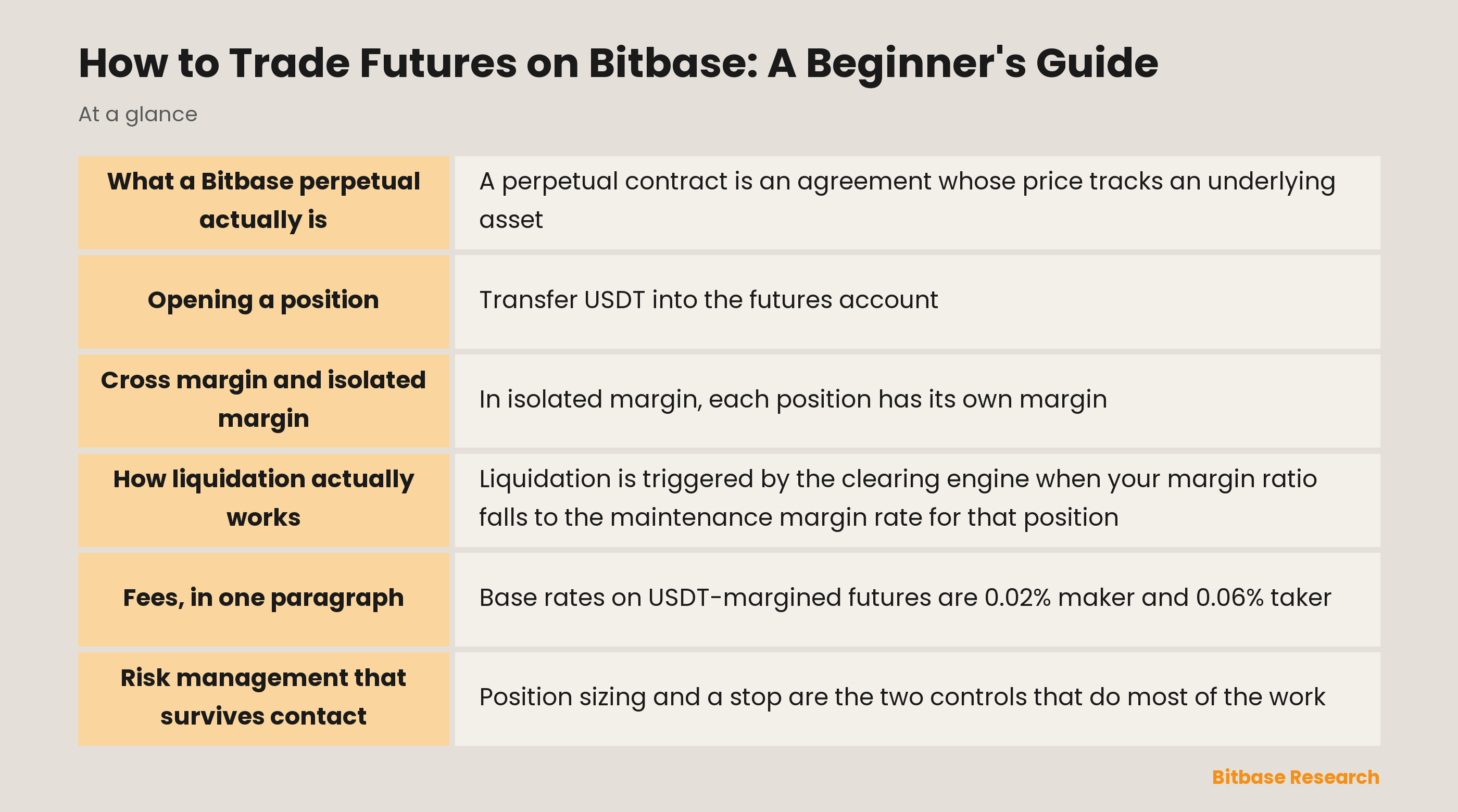
A perpetual contract is an agreement whose price tracks an underlying asset, settled in USDT, with no expiry date. You never hold the coin. You hold a position whose value moves with the coin's price, and you can be long or short with equal ease.
Two mechanisms keep that arrangement honest. The funding rate, typically settled every eight hours, is a payment between long and short holders that pulls the contract price back toward spot whenever it drifts. Only positions open at the settlement instant pay or receive it. And the mark price used for liquidation is set by fair price marking against a weighted average of spot indices from major venues, so a liquidity gap on any single platform cannot trigger liquidations the wider market does not justify.
That second mechanism is worth understanding before you need it. It exists because the alternative, marking against the platform's own last traded price, makes every thin order book a liquidation engine.
Before your first trade: three settings
| Setting | Choose | Why now rather than later |
|---|---|---|
| Margin mode | Isolated for a first position | It caps the loss at what you allocated to that trade |
| Leverage | The lowest that makes the trade worth taking | It sets liquidation distance, which is the real variable |
| Stop-loss | Placed when you open, not when you are down | Deciding an exit while holding a losing position is the worst moment to decide anything |
None of these can be set well under pressure, which is the whole argument for setting them first. A position you opened without a stop is a position whose exit will be chosen by whichever feeling arrives first.
Opening a position
Transfer USDT into the futures account, pick the contract, then set margin mode and leverage before you set size. That order matters, because leverage changes what a given size costs you in margin.
Choose an order type deliberately. A limit order names your price and may not fill; a market order fills now at whatever the book offers. In a fast move the difference between the two is the difference between a price you chose and a price that happened to you.
Then set size by the loss you are willing to take, not by the margin you happen to have. The arithmetic runs backwards from the stop: decide the maximum you can lose on the trade, look at the distance to your stop, and let those two numbers determine the position size. Sizing by available balance is how accounts get closed by one ordinary move.
Cross margin and isolated margin
In isolated margin, each position has its own margin. If it liquidates, the loss is limited to what you assigned to that position and the rest of the account is untouched.
In cross margin, the whole available balance backs every position. Floating losses on one draw on the shared pool, which pushes liquidation further away and improves capital efficiency, and which also means an extreme move on one position can affect the entire account.
The trade is straightforward: isolated contains damage, cross delays it. A first position belongs in isolated, because containment matters more than efficiency while you are still learning what the contract does under stress. Bitbase supports switching between the two modes and between one-way and hedge position modes.
How liquidation actually works
Liquidation is triggered by the clearing engine when your margin ratio falls to the maintenance margin rate for that position. It is arithmetic, not a decision, and it uses the mark price rather than the last trade.
Two consequences follow. Leverage does not increase your risk of being wrong; it decreases the distance between the current price and the price that closes you. At 10x that distance is roughly ten percent before fees and funding; at 50x it is roughly two percent, which is inside the ordinary daily range of most crypto assets. And because liquidation reads the mark price, a wick on one exchange should not close a position that the wider market never justified, which is precisely what fair price marking is for.
Funding is the slow cost that people forget. Held for weeks, a persistently positive funding rate on a long is a recurring charge against the position, and it is paid regardless of whether the trade is working.
Fees, in one paragraph
Base rates on USDT-margined futures are 0.02% maker and 0.06% taker, with a seven-tier VIP ladder above them. Rates change and the fee page is the live source, so treat any number in an article as an illustration rather than a quote. What is worth knowing structurally is that maker orders cost less than taker orders, so the choice between a limit order and a market order is also a fee decision, and that funding is a separate cost from trading fees rather than part of them.
Risk management that survives contact
Position sizing and a stop are the two controls that do most of the work, and both have to exist before the trade rather than after it. Set the stop where your reasoning would be wrong, not where the loss becomes uncomfortable, because those are different prices and only the first one is information.
Two habits beyond that. Do not add to a losing position to lower the average entry, since that converts a bounded loss into an unbounded one. And size for the gap: assets whose underlying markets close overnight can move while you cannot act, so a position sized for continuous trading is oversized for one that gaps.
The wider platform picture is in what is Bitbase, the futures product page has the current contract specifications, and the mechanics of perpetuals in general are covered in what is crypto futures trading.
The bottom line
A Bitbase perpetual is a USDT-settled contract with no expiry, priced against a weighted spot index, with funding settled roughly every eight hours and liquidation triggered arithmetically at the maintenance margin rate.
Open in isolated margin, at the lowest leverage that makes the trade worth taking, with a stop placed at the moment of entry and a size derived from the distance to that stop. Those four choices decide more about the outcome than the direction call does. To keep learning the fundamentals, follow more from Bitbase Academy.
Related reading
Other Bitbase articles on this topic:
- Automatic Margin Addition Explained: What It Does to Your Liquidation Price
- How Funding Payments Affect Your Profit and Loss on a Perpetual
- Crypto Futures Risk Mechanics: Insurance Funds and ADL
- DePIN Network Types
- Diamond Hands, Paper Hands and Jeets
Disclaimer: This article is educational content from Bitbase Academy, provided for information only. It does not constitute investment, trading, tax, or financial advice. Crypto assets are volatile; assess your own risk. Written as of September 2026; refer to the latest official information.
References
[1] Bitbase, About Bitbase — company overview and regulatory registrations www.bitbase.com