Trading stock exposure on Bitbase works through TradFi, which lets you take a position on a listed company from the same balance you use for crypto. There is no brokerage account to open and no separate funding step. What changes is the market underneath: equities keep opening hours, they gap, and they react to scheduled events in ways crypto does not. This guide walks through the order, the sizing and the timing.
Before you place the first order
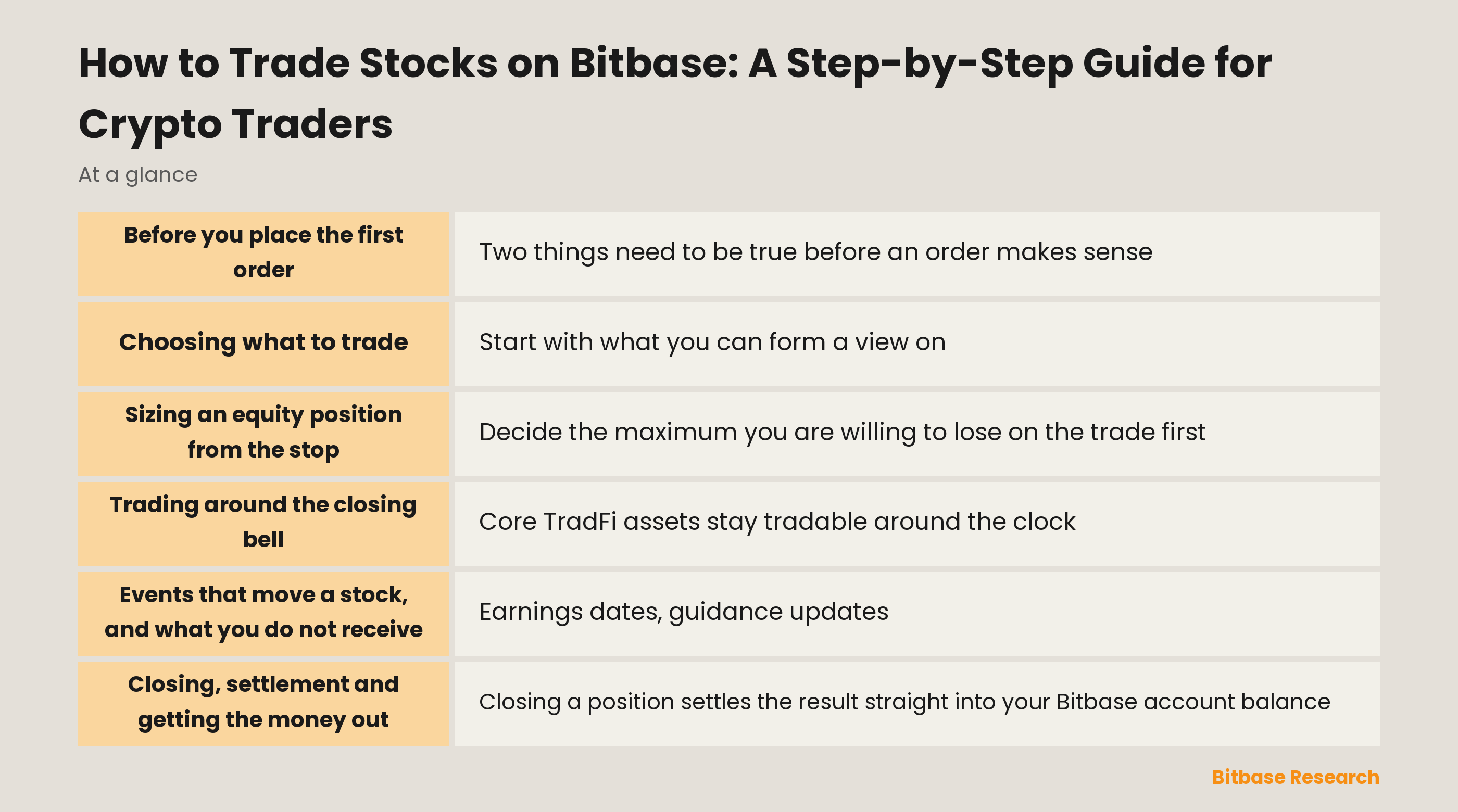
Two things need to be true before an order makes sense. Your Bitbase balance has to be funded, and you have to know what you are actually buying.
The second one is where most beginners go wrong. A stock position on Bitbase is exposure through a price-tracking certificate, not a shareholding. It moves with the listed company's price and it can be taken long or short, but it does not put you on the share register. That distinction is set out in full in what is Bitbase TradFi, and it is worth reading before rather than after your first trade.
The consequence for a crypto trader is small but real. Your instincts about a twenty-four-hour market need adjusting for one that closes, and the adjustment shows up mostly in position size rather than in direction.
Choosing what to trade
Start with what you can form a view on. An index gives you the direction of a whole market without any single company's surprises; a single name gives you the company's fortunes and everything specific that comes with them. Neither is safer in the abstract, but the second requires you to know something particular.
Liquidity is the second filter, and it is more practical than it sounds. A widely traded name has tighter spreads and absorbs your order without moving much; a thin one costs you on entry and again on exit. Since you pay that cost twice on every round trip, it deserves attention before the trade idea does.
The third filter is your own schedule. If you cannot watch a position during the hours its underlying market is open, choose instruments and sizes that survive being unattended. The current instrument list and its parameters are on the TradFi product page.
The order ticket, field by field
| Field | What it decides | A sensible first choice |
|---|---|---|
| Direction | Long or short | Long, until short mechanics are familiar |
| Order type | Whether you name the price or accept it | Limit, so the fill price is yours |
| Leverage | The distance to liquidation | The lowest that makes the trade worth taking |
| Margin mode | Whether one loss can reach the rest | Isolated for a first position |
| Size | How much a wrong call costs | Derived from the stop, not from the balance |
| Stop-loss | Where you exit if wrong | Set at entry, not later |
Leverage on TradFi reaches up to 200x depending on the instrument. That is a ceiling, not a suggestion: the higher the multiple, the smaller the move that closes you, and equities can produce that move overnight while you are unable to act.
Sizing an equity position from the stop
Decide the maximum you are willing to lose on the trade first. Then look at the distance between your entry and the price at which your reasoning would be wrong. Those two numbers determine the position size, and nothing else should.
Sizing from your available balance instead is the single most common way a first position becomes the last one. It answers the question of how much you can put on rather than how much you should, and those have different answers on every trade you will ever place.
Set the stop where the idea breaks, not where the loss becomes uncomfortable. Those are different prices, and only the first one carries information. For the mechanics of leverage and liquidation in more depth, see how to trade futures on Bitbase.
Trading around the closing bell
Core TradFi assets stay tradable around the clock, but the market each one tracks does not. That asymmetry is the main thing separating this from crypto trading.
Outside the underlying market's hours, liquidity is generally thinner, spreads widen, and the same order size slips further. An entry that costs almost nothing during the main session can cost noticeably more overnight, so timing an entry is a cost decision as well as a directional one.
The gap is the bigger risk. While a market is closed, news keeps arriving and expresses itself all at once when it reopens. A stop placed inside a gap does not protect the price you chose; it executes on the other side of the jump. The defence is not avoiding the hours but sizing for them, because a position sized for continuous trading is oversized for one that can gap.
Events that move a stock, and what you do not receive
Earnings dates, guidance updates, sector news and index rebalancing move listed companies in ways that have no crypto equivalent. Most of them are scheduled, which makes them the rare kind of risk you can see coming and choose whether to hold through.
What you do not receive is the shareholder side of those events. Because you hold a price-tracking certificate rather than a share, dividends and voting rights belong to the register you are not on. Price effects still reach you, since they are price, but entitlements do not. For the terms attached to any specific instrument, read its details on the product page rather than assuming the equity convention carries over.
Funding is the other recurring cost, adjusted dynamically by supply and demand and settled on a cycle. It can swing more widely when the underlying market is shut, which is worth checking before carrying a leveraged position across a weekend.
Closing, settlement and getting the money out
Closing a position settles the result straight into your Bitbase account balance. There is no separate broker to withdraw from and no second settlement cycle to wait through.
From there the money behaves like everything else you hold on the platform, and it can be withdrawn to a bound wallet address. What it costs to move is a network question rather than a trading one, and it is covered in Bitbase withdrawal fees.
Your trading costs on the way in and out follow the same VIP level as the rest of the account, which means activity anywhere in it lowers your rates everywhere in it. The calculation is set out in the Bitbase VIP fee guide.
The bottom line
Trading stocks on Bitbase means taking exposure through TradFi from your existing balance, with no brokerage account and no separate funding. Choose the instrument by what you can form a view on and by how liquid it is, set margin mode and leverage before size, and derive the size from the distance to your stop.
The one habit that transfers badly from crypto is sizing for a market that never closes. Equities close, information accumulates while they do, and it arrives as a gap rather than a slide. Size for that and the rest of the process is familiar. Current instruments and parameters are on the TradFi product page. For more from Bitbase Academy, keep reading.
Related reading
Other Bitbase articles on this topic:
- How to Trade MSTR: Strategy and Its Bitcoin Balance Sheet
- How to Trade MU: Micron Memory, Spot and Perpetual Futures
- Nasdaq-100 Futures and What NQ Settles Against
- How to Buy and Trade NFLX: Netflix Without a Subscriber Count
- How to Buy ORCL: Oracle Cloud, the Token and the Perpetual
Disclaimer: This article is educational content from Bitbase Academy, provided for information only. It does not constitute investment, trading, tax, or financial advice. Crypto assets are volatile; assess your own risk. Written as of September 2026; refer to the latest official information.
References
[1] Bitbase, TradFi — product page and FAQ on tokenised traditional assets www.bitbase.com