NQ and MNQ are written on the same index, quote in the same increments, and stop trading on the same afternoons. The only thing separating them is how many dollars one index point is worth, and that single ratio of one to ten propagates into margin, into the smallest position that can be carried, and into how many contracts a roll has to move. What it does not change is risk per dollar of exposure.
The Same Index in Two Sizes
The E-mini Nasdaq-100 futures contract, ticker NQ, is $20 times the Nasdaq-100 index. The Micro E-mini Nasdaq-100, ticker MNQ, is $2 times the same index. Nothing else in the definition moves: same underlying, same listed months, same exchange, same settlement procedure. The Micro is the E-mini divided by ten, and it exists so a position can be scaled down without changing how the instrument behaves.
One clarification removes most of the confusion around these tickers. NQ tracks the Nasdaq-100 index, and QQQ is an exchange-traded fund that tracks the same index. Calling NQ "QQQ futures" folds two products into one name: a fund share is ownership of a portfolio, a futures contract an agreement about an index level. What that fund becomes on a crypto venue is a separate subject; how the index itself is built is set out in the Nasdaq-100 futures profile.
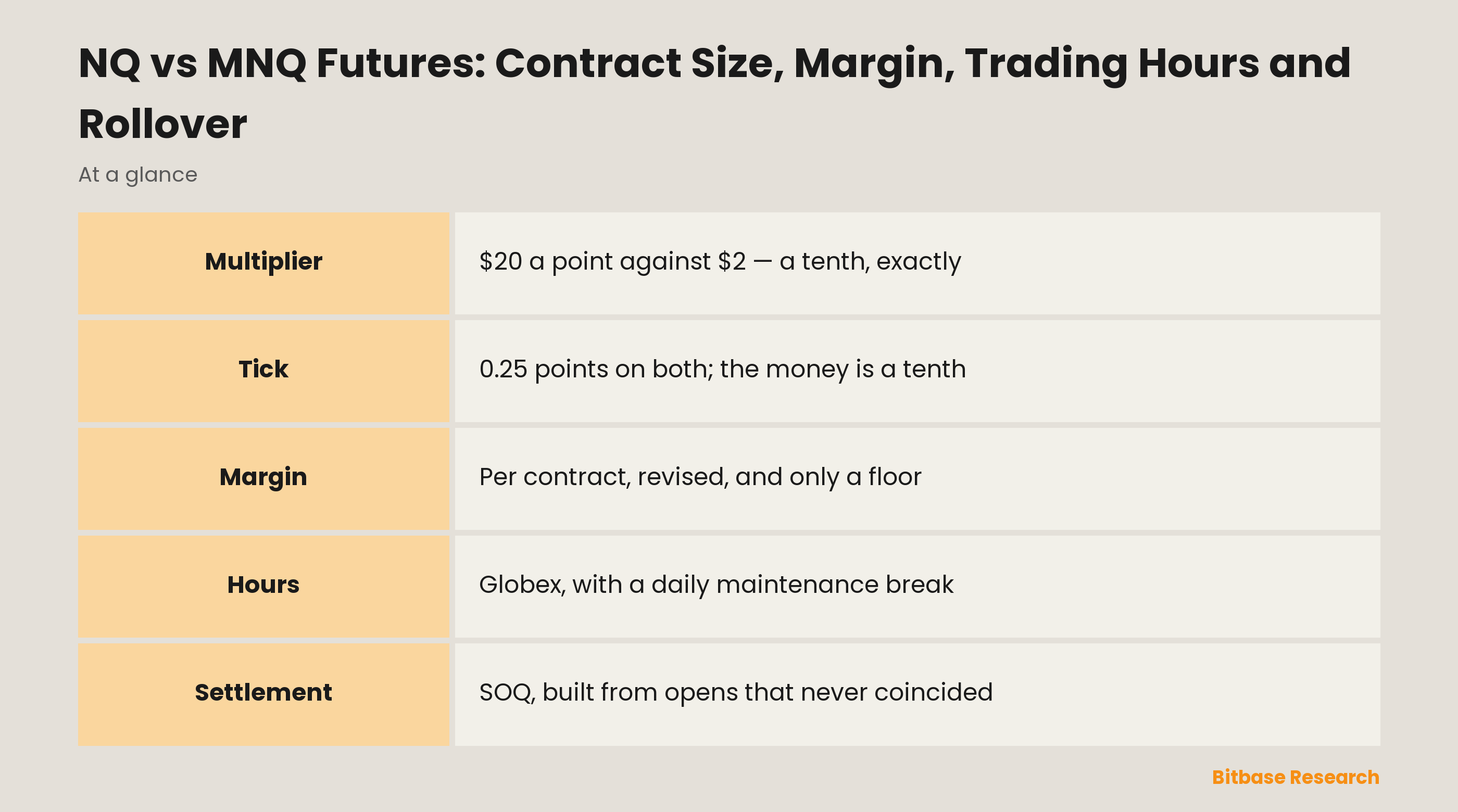
The tick is the other place to be exact. Both quote in minimum increments of 0.25 index points — the same price resolution, not a tenth of it. Because the multiplier is a tenth, the money in one tick is a tenth too: a tick is $5 on NQ and fifty cents on MNQ. MNQ gives no finer view of the market, only a finer view of the account.
Reading the Two Specifications Side by Side
| Specification | NQ (E-mini) | MNQ (Micro E-mini) |
|---|---|---|
| Multiplier | $20 per index point | $2 per index point |
| Minimum tick | 0.25 index points | 0.25 index points |
| Money in one tick | $5 | A tenth of the E-mini |
| Listed months | March, June, September, December | Same |
| Last trading day | Third Friday of the contract month | Same |
| Settlement | Cash, against an opening calculation | Same |
| Session | CME Globex, Sunday evening to Friday afternoon | Same |
Only the first three rows differ, and all three by the same factor. The rest is identical, which is the point: choosing between NQ and MNQ is a sizing decision, not a decision about which market to be in.
Why the Micro Carries a Tenth of the Margin
Margin here is neither a fee nor a price. It is a performance bond posted so the clearing house stays covered, and it is set per contract. A Micro carries a tenth of an E-mini's notional, so the bond covering it is a tenth too: ten MNQ call for close to the margin of one NQ, because they are close to the same position.
That equivalence is why "the Micro is less risky" is the wrong sentence. What is smaller is the contract's face value, not the leverage and not the risk. Leverage is the ratio between notional and the money behind it, and it depends on how many contracts are held, not on which.
Two mechanics matter more than any figure. Exchange margin is revised as volatility moves, so a number copied out of a guide has already changed. And it is a floor, not a ceiling: a broker may ask for more. That is why no amount appears here — the binding number lives on the exchange's specification page and the broker's, and has to be read on the day.
Three Calendars That Do Not Line Up
A position in NQ or MNQ sits between three schedules, and most of the surprises these contracts produce come from assuming there is one. The contract's own is CME Globex: Sunday 18:00 ET through Friday 17:00 ET, with a daily maintenance break from 17:00 to 18:00 ET. Close to continuous, but not 24/7, and the hour that disappears each evening is an hour in which no order can be worked.
The underlying's schedule is the US cash equity session, which is far shorter. For most of any weekday the contract quotes a market whose constituent shares are not trading, so an overnight move exists in the futures first and reaches the index only when those shares reopen.
The third belongs to a different instrument: a perpetual has no maintenance break and no expiry, paying periodic funding instead of rolling, and that trade-off is worked through in full elsewhere. Reading a futures session as though it were a perpetual's is the surest way to be caught out on a Friday afternoon.
The Quarterly Roll
Both are listed on the quarterly cycle of March, June, September and December, and each stops trading on the third Friday of its month. A position meant to outlast that date has to be rolled — expiring contract closed, next one opened — because nothing carries it forward on its own.
The cost of a roll is not a fee. It is the price difference between the two contracts at the moment they are traded, plus what the spread and the depth cost that day. That is structurally unlike funding: a roll is lumpy and scheduled, funding is smooth and continuous. Neither is cheaper as a rule — they are shaped differently, and the shape is what a holding period runs into.
Rolling MNQ carries one asymmetry. Since the Micro is a tenth of the size, the same exposure is ten times as many contracts to move. Invisible at one or two; at size it becomes an execution question of its own.
What the Final Settlement Price Actually Is
Both contracts are cash-settled, and the number they settle against is the Special Opening Quotation, shortened to SOQ. It is calculated, in the exchange's own words, "based on the opening price of each component stock in the relative index, regardless of when those stocks open."
Both halves of that sentence do work. The inputs are opening prices — not closes, not a mid-session reading — and each is that stock's own opening price, taken whenever that particular stock opens, which on a third Friday can be spread across many minutes.
What follows is the part that catches people out. The settlement value is assembled from prices that never existed at the same moment. It is not a snapshot of the index at any instant, so it can differ from every index level printed that day, including the one showing when the contract stops trading. A position held to expiry settles at a construction — which is reason enough to treat the third Friday as a date with mechanics of its own.
The Bottom Line
NQ and MNQ are one contract in two sizes: $20 and $2 per index point, the same 0.25-point tick, the same quarterly months, the same cash settlement. The Micro lowers the smallest position that can be held; it lowers neither leverage nor risk per dollar of exposure. Margin scales with notional and is only a floor beneath whatever a broker asks. Three calendars run at once, and only Globex is the contract's. And four times a year both settle against a number built from opening prices that were never simultaneous.
Related reading
Other Bitbase articles on this topic:
- ES vs MES Futures: Contract Size, Margin, Trading Hours and Rollover
- FOMC and Equity Derivatives: Volatility, Execution and Position Risk
- Stock Perpetual Funding Rates: Calculation, Direction and Holding Costs
- Memetic Premium: Why Memes Move Prices
- Range Trading Strategy
Disclaimer: This article is educational content from Bitbase Academy, provided for information only. It explains what a company or fund does and how the instruments referenced here differ from one another; it does not constitute investment, trading, tax, or financial advice, and it is neither a recommendation nor an endorsement of any security, token, or trading strategy. A tokenized stock is issued by a third party and is designed to give economic exposure to an underlying asset: it is not a share, it carries no shareholder rights, and it depends on the issuer's structure, eligibility rules, and redemption terms, which the issuer can change. Perpetual futures are leveraged derivatives that hold no underlying asset and can be liquidated, and trading hours, product availability, and eligibility differ by instrument and by jurisdiction and can change at any time. Written as of September 2026; verify everything yourself through company filings, the issuer's own documentation, and the product pages of the venue you trade on.
References
[1] CME E-mini Nasdaq-100 contract specifications: multiplier, tick, listed months and final settlement www.cmegroup.com
[2] CME Micro E-mini Nasdaq-100 contract specifications: a tenth of the E-mini, same tick and hours www.cmegroup.com