You tap a card once, and four separate companies are paid out of that single purchase, each for a different job and each charging a different fee. A payment technology stock is a claim on one of those layers, never on the whole chain. The useful question is not whether a company does payments; it is which fee reaches it, and which risk stays with somebody else.
Four Roles Behind One Purchase
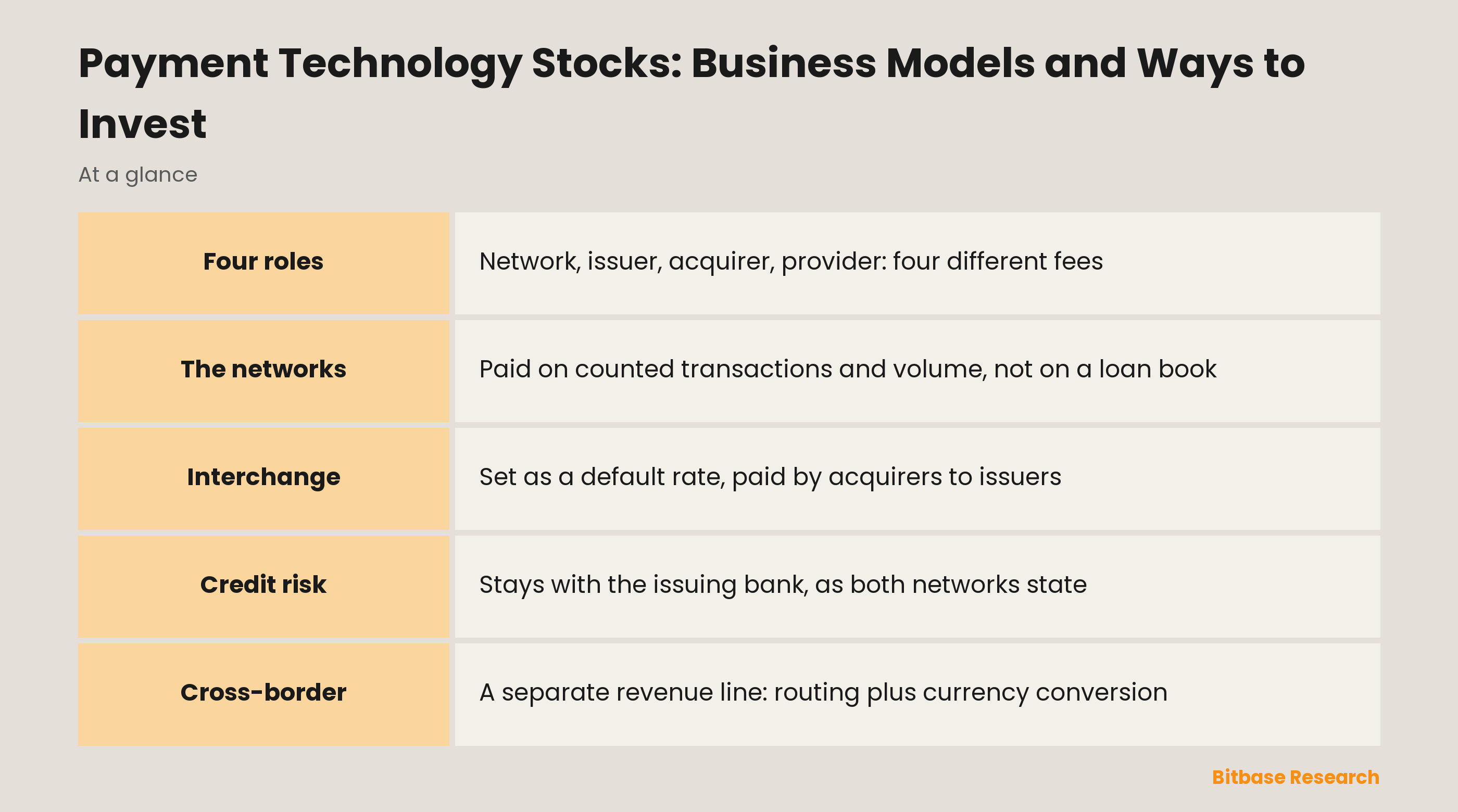
Card payments run on a four-party arrangement, and those four parties are separate businesses with separate annual reports. The card network carries the authorisation message and the settlement instruction between banks. The issuer is the bank that handed the shopper the card and posts the purchase to that account. The acquirer signs up the merchant and pays it for the sale. The payment service provider sits in front of the merchant with the checkout, the terminal, the software and often the fraud decision.
Four positions, four collections out of one purchase, and no filing covers all of them because no company occupies all of them. Work out which layer a company sits in first.
| Layer | What it does | Where its money comes from | Cardholder credit risk |
|---|---|---|---|
| Network | Authorisation, clearing and settlement between banks | Fees charged to issuers and acquirers | No |
| Issuer | Issues the card, posts the purchase, lends the money | Interchange, plus interest and account fees | Yes |
| Acquirer | Signs the merchant and pays it for the sale | Its own markup over the costs it passes through | No |
| Provider | Checkout, terminal, software, fraud decisions | Fees on the volume it processes, plus subscriptions | Read the filing |
What the Networks Actually Sell
Visa Inc. is a Delaware company whose Class A common stock is registered on the New York Stock Exchange under the symbol V, and whose annual report covers a year ending in September rather than December. Mastercard Incorporated, also Delaware, lists its Class A common stock on the same exchange under MA and reports on the calendar year. Two neighbours in one business, two reporting clocks.
Visa names four revenue lines: service, data processing, international transaction and other, with data processing earned for authorisation, clearing and settlement, network access and support. Mastercard's revenue note cuts the company a different way, into payment network and value-added services and solutions. Payment network revenue, it states, comes from fees charged to issuers, acquirers and other market participants for switching and other network-related services, and from fees based primarily on the gross dollar volume of activity on cards carrying its brands.
Set those two descriptions side by side and the shape underneath them is identical. What a network is paid follows counted transactions and the volume they carry, not a loan book and not a portfolio.
The Fee the Network Sets and Does Not Keep
Interchange is the fee most people have heard of and the one most often credited to the wrong company. Visa's filing says it establishes default interchange reimbursement fees that apply absent other settlement terms, that those fees are generally paid by acquirers to issuers, and then draws the line: the fees Visa receives from issuers and acquirers are not derived from them. Mastercard's wording matches. Default interchange fees are established by Mastercard or, alternatively, by financial institutions, and interchange is collected from acquirers and paid to issuers to reimburse them for part of the costs they incur.
So one fee is set by the network and flows straight past it to the issuer, a second is the network's own charge and stays with it, and a third, the merchant's cost above what the acquirer passes through, is set by the acquirer, which Mastercard states outright it does not control. Three fees on one purchase, three different parties deciding them. Each is regulated differently in every market, which is why a guide is the wrong place for a number.
Who Carries the Cardholder's Credit Risk
Both networks volunteer the sentence that separates them from a bank. Visa writes that it is not a financial institution, does not issue cards, extend credit or set rates and fees for account holders, and neither earns revenue from nor bears credit risk on those activities. Mastercard writes that it does not issue cards, extend credit, or determine or receive revenue from the interest rates issuers charge account holders.
A shopper who falls behind is consequently the issuer's exposure, not the network's. That splits the two tickers apart: one line responds to how much gets spent, the other to how much gets borrowed and then repaid, and those answers arrive on different calendars. The company-level reading of that boundary sits in the pages on Visa's filing language and on Mastercard as the network in the middle.
The Cross-Border Line Is Reported on Its Own
Visa gives international transaction revenue a named line of its own, earned from cross-border transaction processing and currency conversion activities. Mastercard folds the same traffic into gross dollar volume, which it defines as covering both domestic and cross-border volume.
Two jobs are bundled inside that line: routing a transaction between countries, and converting one currency into another. A border therefore changes the economics of an otherwise identical purchase. Travel, imported goods and currency movement reach these companies through a line that a domestic reading of consumer spending would miss.
The Merchant Side: Wallets, Acquirers and Gateways
PayPal Holdings, Inc. lists on the Nasdaq Global Select Market under PYPL and states its revenue model plainly: it earns primarily by charging fees for completing payment transactions and other payment-related services, typically based on the volume of activity processed on its platform. A second line covers other value-added services, which the filing lists as partnerships, interest and fees from consumer and merchant credit products, interest earned on certain assets underlying customer balances, referral fees, subscription fees and gateway services. A credit book and an interest-rate exposure sit inside a company most readers file under the word wallet.
Block, Inc., registered on the New York Stock Exchange under the symbol XYZ and named Square, Inc. until the end of 2021, reports two segments, Square and Cash App, and three revenue categories: Commerce Enablement, Financial Solutions and Bitcoin Ecosystem. Financial Solutions is described as banking, lending and money management products for individuals and businesses, and the company runs a wholly owned subsidiary bank, Square Financial Services, alongside third-party bank partners. The ticker also carries a market page on Bitbase, though the segment names are the part worth remembering.
What the Filings Say About Crypto
Block is the cleanest case here because the crypto exposure is not an inference. Bitcoin Ecosystem is one of the three revenue categories in the annual report, covering consumer and business bitcoin products. Hold every other crypto claim in this sector to that standard: either the business appears in the company's own revenue categories, or it does not, and an announcement is not a filed category.
How a crypto payment actually reaches a merchant, through a gateway, a custody step, a conversion and a settlement record, is a separate mechanism, set out in crypto payment gateways and merchant settlement. This page answers the other half: which listed company gets paid.
What to Open Before Buying Anything
Begin at the cover page, for the legal name, the exchange, the symbol and the fiscal year end. Move to Item 1 for the segments and revenue categories in the company's own words. Then read Item 1A, where a company lists the structural risks it wants shareholders to weigh, and read the headings before the paragraphs.
Visa's own report shows what that section is for. It warns that government-imposed obligations or restrictions on international payment systems may prevent it from competing against providers in certain countries, naming China and India among them. A limit on where a network may operate at all never appears as a revenue line, and no ratio recovers it. Ranked lists of the best names in a sector age faster than the businesses do, for the reasons set out in how to choose these stocks without a ranking.
The Bottom Line
Payment technology is not one business, so a payment technology stock is not one exposure. A network is paid on counted transactions and says in writing that it neither lends nor carries the cardholder's credit risk. An issuer receives interchange and interest, and carries that risk. An acquirer sets its own markup. A provider is paid on processed volume and may, as these filings show, run a lending book as well. Every sentence above comes from the annual report of the company named in it.
Related reading
Other Bitbase articles on this topic:
- How to Buy RSP: Equal Weighting, Costs and Comparison with SPY
- How to Buy SCHD: Dividend Exposure, Costs and Comparison with QQQ
- How to Buy Snowflake (SNOW) Stock: Trading Methods, Costs and Risks
- Tokenization Infrastructure Stocks: Listed Companies and Real Business Exposure
- VWAP Explained for Crypto Traders
Disclaimer: This article is educational content from Bitbase Academy, provided for information only. It explains what a company or fund does and how the instruments referenced here differ from one another; it does not constitute investment, trading, tax, or financial advice, and it is neither a recommendation nor an endorsement of any security, token, or trading strategy. A tokenized stock is issued by a third party and is designed to give economic exposure to an underlying asset: it is not a share, it carries no shareholder rights, and it depends on the issuer's structure, eligibility rules, and redemption terms, which the issuer can change. Perpetual futures are leveraged derivatives that hold no underlying asset and can be liquidated, and trading hours, product availability, and eligibility differ by instrument and by jurisdiction and can change at any time. Written as of September 2026; verify everything yourself through company filings, the issuer's own documentation, and the product pages of the venue you trade on.
References
[1] Visa Inc. Form 10-K: listed securities, revenue lines and interchange www.sec.gov
[2] Mastercard Form 10-K: revenue note and the limits it sets on its own role www.sec.gov
[3] Block, Inc. Form 10-K: two segments and three revenue categories www.sec.gov
[4] PayPal Holdings Form 10-K: transaction revenue and value-added services www.sec.gov