After FTX collapsed in 2022 with an estimated eight-billion-dollar hole between what it claimed to hold and what it actually held, "proof of reserves" became a rallying cry for exchange transparency. But the phrase is often misunderstood, and reserves alone can be dangerously misleading. Here is what proof of reserves really proves — and, just as importantly, what it does not.
What proof of reserves is
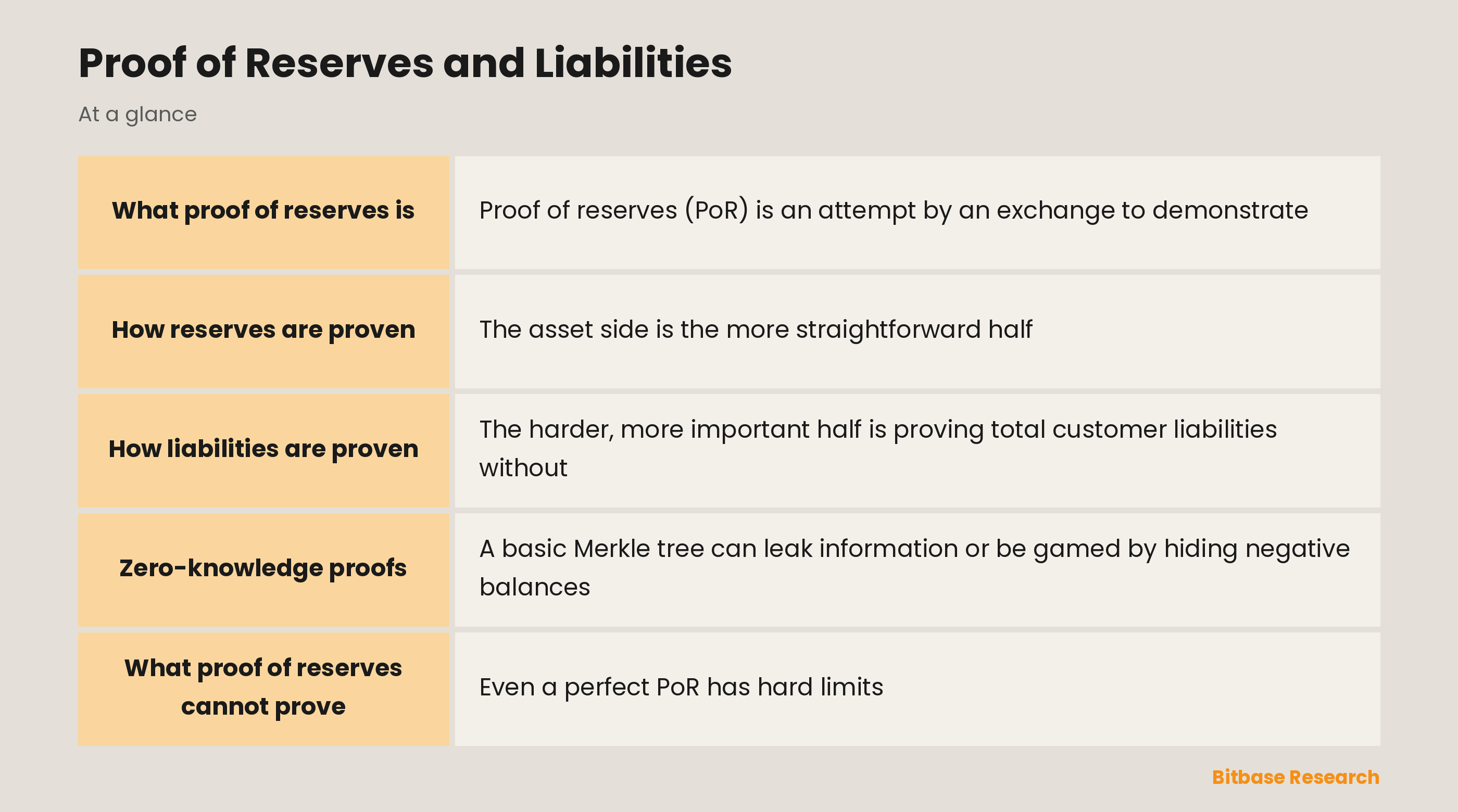
Proof of reserves (PoR) is an attempt by an exchange to demonstrate cryptographically that it actually holds the assets its customers are owed. The idea rose to prominence after FTX showed that a healthy-looking platform can be secretly insolvent. A credible PoR has two halves that must be checked together: proving the exchange controls enough assets, and proving how much it owes customers. Only when both sides line up does "we have the funds" mean anything.
How reserves are proven
The asset side is the more straightforward half. An exchange discloses the blockchain addresses holding its reserves, and because balances are public, anyone can verify the totals on-chain. To prove it actually controls those wallets rather than borrowing an address, the exchange can sign a message with the corresponding keys or move a specified amount on request. This shows the coins exist and are controllable — but says nothing yet about how many people have a claim on them.
How liabilities are proven
The harder, more important half is proving total customer liabilities without exposing individual balances. The standard tool is a Merkle tree: every customer balance becomes a leaf, hashed together in pairs up to a single root that represents the sum of all balances. Each user can independently check that their own balance is included in that root, so the exchange cannot quietly shrink its stated liabilities. Comparing the proven liabilities against the proven reserves is what reveals whether the exchange is actually backed.
Proof of assets, proof of reserves, proof of solvency
These four phrases are used interchangeably in marketing, and they are four different claims.
| Term | What it proves | What it leaves open |
|---|---|---|
| Proof of assets | Some wallets hold coins, and the exchange can sign for them | Whether anyone else has a claim on those coins |
| Proof of reserves | Those holdings are presented as backing for customer balances | How large the total of customer balances actually is |
| Proof of liabilities | The full set of customer balances sums to a published figure | Whether debts that never touch the chain exist |
| Proof of solvency | Reserves cover liabilities, both proven together | That it still holds after the moment of the snapshot |
Only the last row is a statement about solvency, and it is the only one that needs both halves at once.
Zero-knowledge proofs
A basic Merkle tree can leak information or be gamed by hiding negative balances. Modern PoR adds a zero-knowledge proof, typically a zk-SNARK, layered on top of the tree. It lets the exchange prove that every customer balance was included and that all balances are non-negative and sum to the published figure — all without revealing any individual's holdings. This closes the loopholes of earlier designs and is now considered the gold standard for a serious proof of liabilities.
What a reserves-only proof misses
Many published proofs stop at the asset side, and that half alone cannot answer the question people ask of it. A wallet listing gives you a numerator with no denominator: you can see what is held, but not what is owed, so no ratio can be formed and "fully backed" stays an assertion rather than a result.
The gaps are specific. Assets can be borrowed shortly before the snapshot and returned after it, and the chain records only that they were there. Accounts can be left out of the tree, which shrinks the stated liabilities without touching the assets. Balances can be recorded as negative to offset others, unless the design forbids it. And the same coins can appear in more than one entity's proof if nothing binds a wallet to one set of customers.
This is why a reserves-only publication should be read as a partial disclosure. It is better than silence, because the addresses can be checked by anyone. It is not a claim about solvency, and treating it as one is the mistake the phrase invites.
What proof of reserves cannot prove
Even a perfect PoR has hard limits, which is why the stronger goal is called proof of solvency. It is a snapshot at one moment, so an exchange could borrow funds to pass the check and return them after. It cannot see off-chain liabilities — debts, loans, or obligations that never touch the blockchain — so an exchange can be fully "reserved" on-chain yet deeply insolvent overall. And it does not prove the assets are unencumbered rather than pledged elsewhere. PoR raises the bar; it does not remove trust.
The bottom line
Proof of reserves is a real advance in exchange transparency: a good one pairs verifiable on-chain reserves with a Merkle-tree, ideally zero-knowledge, proof of customer liabilities, updated regularly. Treat a credible, current PoR as a genuine positive and its absence as a warning. But never mistake it for a guarantee of solvency, because off-chain debts stay invisible — which is why the safest reserve of all is the crypto you have withdrawn to your own wallet.
Frequently asked questions
Is proof of reserves the same as an audit?
No, and the two answer different questions. An audit is an opinion issued by an accountable firm about a whole balance sheet under a defined standard, covering the off-chain obligations a proof cannot see. A proof of reserves is a cryptographic check of one side at one moment, which anyone can repeat without trusting the firm. A serious transparency programme uses both, and neither substitutes for the other.
Can an exchange pass proof of reserves and still be insolvent?
Yes. Debts that never touch the chain stay invisible to it, assets pledged as collateral elsewhere still show up in the wallet, and funds borrowed for the snapshot look identical to funds that were always there. That is why the honest claim is about reserves at a moment, not about solvency.
What should I look for in a published proof?
Whether liabilities are proven alongside assets, whether the design forbids negative balances, how often the proof is republished, whether an independent party attests to it, and whether you can confirm your own balance is inside the tree. A proof you cannot check yourself is a press release.
Related reading
Other Bitbase articles on this topic:
- Stablecoin Depegs: Why the Peg Breaks and How It Recovers
- What Is Solstice? USX, eUSX, and SLX Roles
- What Is Stable Network? A USDT0-Denominated Gas Design
Disclaimer: This article is educational content from Bitbase Academy, provided for informational purposes only. It is not investment, trading, tax, or financial advice. Written as of July 2026; rely on the latest official information.
References
[1] Vitalik Buterin, "Having a safe CEX: proof of solvency and beyond" vitalik.eth.limo
[2] CoinDesk, "Proof of reserves explained" coindesk.com