
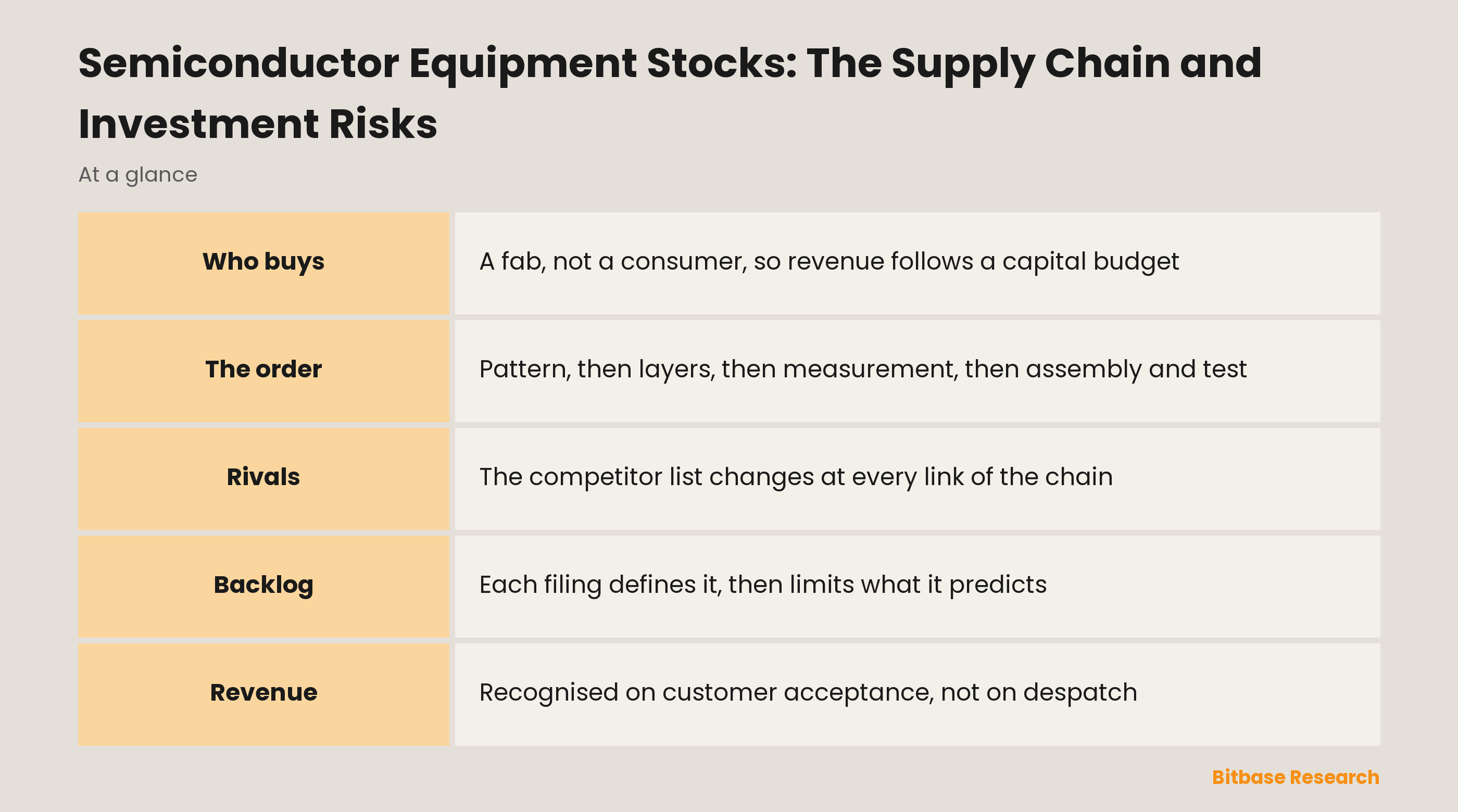
Before a wafer can become a chip it passes through a fixed sequence of machines, and each step in that sequence is supplied by a different set of listed companies. Because the buyer is a fabrication plant rather than a consumer, revenue follows a customer's capital budget rather than chip shipments, and a capital budget is a decision made years ahead. What follows reads four of these companies' own annual filings and points at the paragraph where each statement can be checked.
Who Signs the Purchase Order
Equipment makers sell to the people who own fabs: foundries, integrated device manufacturers and memory producers. Nobody else buys these machines, and the filings are explicit about what that means for revenue.
KLA states that its business "depends upon the capital expenditures of semiconductor, semiconductor-related and electronic device manufacturers, which are driven by current and anticipated market demand for ICs and the products that use them." ASML says the same of its own products: sales "depend in large part on the level of capital expenditures by semiconductor manufacturers."
A capital budget is not a demand curve. Chips can sell briskly while the fabs making them run on capacity already installed, and fabs can build ahead of demand that never arrives. Applied Materials lists what its customers weigh before spending: "general economic conditions; anticipated market demand and pricing for semiconductors and other electronic devices; the development of new technologies; customers' factory utilization; capital resources and financing; trade policies and export regulations; and government incentives." Demand for the finished chip is one entry among seven.
So a chip designer and a toolmaker are not the same position. Nvidia sells the chip, TSMC owns the fab that prints it, and the equipment names get paid when that second group decides to expand.
The Chain Runs in an Order
Wafer processing is sequential, and the order is not a metaphor: each stage has to finish before the next can start. Where a company sits in that order tells you whom it invoices and which rivals it meets.
| Stage, in order | What happens to the wafer | A listed supplier, in its own filed words |
|---|---|---|
| Pattern | Circuit geometry is printed onto the wafer | ASML gives chipmakers "hardware, software and services to mass produce the patterns of integrated circuits" |
| Layer | Material is added, etched away and cleaned off around that pattern | Lam Research is "a global supplier of innovative wafer fabrication equipment and services", with "expertise in deposition, etch, and clean markets" |
| Measure | Finished layers are inspected and measured against target | KLA sells "inspection, metrology and software products" that "help IC, wafer, reticle/mask and chemical/materials manufacturers achieve target yields" |
| Assemble and test | Finished dies are packaged, mounted and checked | KLA's PCB and Component Inspection segment lets "electronic device manufacturers inspect, test and measure PCBs, IC substrates and packaged ICs" |
Applied Materials spans the front end rather than one column, reporting "two reportable segments: Semiconductor Systems and Applied Global Services® (AGS)", the first of which "designs, develops, manufactures and sells a wide range of equipment used to fabricate semiconductor chips". Two suppliers with the same customers can still be exposed to different parts of a fab's budget, and the segment note is where that shows.
Each Link Names Its Own Rivals
Because the stages are different pieces of engineering, the competitor list changes along the chain, and each company files its own.
ASML writes that it competes "primarily with Canon and Nikon in respect of DUV systems", and separately with "providers of applications that support or enhance complex patterning solutions, such as Applied Materials Inc. and KLA-Tencor Corporation." One firm, two competitive sets, both named by the firm. Our page on trading ASML covers what that exposure looks like as an instrument.
Lam Research devotes a whole risk factor to how hard the chain is to re-enter once a choice is made, under the heading "Once a Semiconductor Manufacturer Commits to Purchase a Competitor's Semiconductor Manufacturing Equipment, the Manufacturer Typically Continues to Purchase That Competitor's Equipment, Making It More Difficult for Us to Sell Our Equipment to That Customer." That is a moat and a ceiling in one sentence.
Concentration does not stop at the equipment makers. ASML calls Carl Zeiss SMT "our sole supplier of lenses, mirrors, illuminators, collectors and other critical optical components", and says that were that relationship to end, "we would effectively cease to be able to conduct our business." The chain continues upstream of the listed names.
Why the Current Quarter Is the Wrong Line
These are large machines on long lead times, so orders, cash and revenue land on different dates. The filings name the measure to watch, then say how far it can be trusted.
Applied Materials defines it: backlog "consisted of: (1) orders for which written authorizations have been accepted, or shipment has occurred but revenue has not been recognized; and (2) contractual service revenue and maintenance fees." It limits it in the next breath — backlog "on any particular date is not necessarily indicative of actual sales for any future periods", being "subject to change, including the addition of new orders, potential amendments or cancellations of existing orders, and changes in export rules and regulations."
KLA is blunter. After listing the variables — "lead-time expectations, changes in government regulations, the readiness of customer fabs, end market needs for capacity, changes in the estimated versus actual start time of customers' projects, timing of delivery and installation dates and supply chain constraints" — it concludes that its backlog "does not provide meaningful information about the timing of future revenue recognition."
ASML supplies the mechanism. It describes shipping some systems early, with "some final testing and formal acceptance carried out on customer sites instead of at our own facilities", which "typically leads to a delay of revenue recognition for those shipments until formal customer acceptance". Revenue is recognised on acceptance, not on despatch — a tool that has left the factory can sit unrecognised across a reporting boundary.
The Installed Base Is a Second Revenue Line
A tool inside a fab keeps generating invoices, and each company reports that stream separately. ASML's definition is the tightest: "Installed Base Management sales equals our net service and field option sales." Applied Materials gives the work a segment, AGS, which "provides services, spares and factory automation software to customer fabrication plants globally". Lam Research houses it in its Customer Support Business Group, offering "customer service, spares, upgrades, and new and refurbished non-leading edge products in our deposition, etch, and clean markets". KLA's services business "provides maintenance and other services to maximize uptime, productivity and tool life for our customers."
This line moves to a different rhythm from system sales, tracking tools already installed rather than tools being bought. It is not guaranteed either: ASML names the ways it can shrink, since customers "may perform more of these services themselves, find other third-party suppliers to provide them, or we may be limited by export control restrictions."
Where Export Rules Sit in These Filings
All four file trade and export regulation as a named risk, and no two file it under the same heading. Applied Materials carries one heading on export regulations and a second reading "We are exposed to risks and uncertainty related to changes in trade policies, and increased tariffs and trade disputes." ASML files it under "We are exposed to economic, geopolitical and other developments in our international operations", classified as a strategic risk. KLA's heading names the specific United States agency whose rules it is describing. Lam Research's names a single region and its sales into it.
Read each company's own Item 1A rather than treating this as one sector-wide fact. The heading shows how that board frames the exposure and where in the filing the detail sits; the content beneath it changes, which is why none of it is repeated here. Applied Materials also lists changes in export rules among the things that move its backlog, which ties this section back to the one above.
The Bottom Line
Semiconductor equipment resists the usual shortcuts. The customer is a fab, so revenue tracks a capital budget; the order is long-dated, so the quarter is set by acceptance dates; and concentration differs at every stage instead of being one number for the group. Each of those claims sits in a document you can open: Item 1 for the segments, the backlog paragraph for the timing, Item 1A for the risks each board chose to name. If you would rather not choose between the names, a semiconductor sector fund swaps those choices for an index rule, which is simply another document to read.
Related reading
Other Bitbase articles on this topic:
- How to Buy RSP: Equal Weighting, Costs and Comparison with SPY
- How to Buy SCHD: Dividend Exposure, Costs and Comparison with QQQ
- How to Buy Snowflake (SNOW) Stock: Trading Methods, Costs and Risks
- Tokenized Stock Risks: Issuers, Liquidity, Price Tracking and Redemption
- Crypto Trading Journal: Turn Every Trade Into a Lesson
Disclaimer: This article is educational content from Bitbase Academy, provided for information only. It explains what a company or fund does and how the instruments referenced here differ from one another; it does not constitute investment, trading, tax, or financial advice, and it is neither a recommendation nor an endorsement of any security, token, or trading strategy. A tokenized stock is issued by a third party and is designed to give economic exposure to an underlying asset: it is not a share, it carries no shareholder rights, and it depends on the issuer's structure, eligibility rules, and redemption terms, which the issuer can change. Perpetual futures are leveraged derivatives that hold no underlying asset and can be liquidated, and trading hours, product availability, and eligibility differ by instrument and by jurisdiction and can change at any time. Written as of September 2026; verify everything yourself through company filings, the issuer's own documentation, and the product pages of the venue you trade on.
References
[1] Applied Materials 10-K: segments, what customers weigh before spending, backlog, Item 1A headings www.sec.gov
[2] Lam Research 10-K: what it supplies, the Customer Support Business Group, Item 1A headings www.sec.gov
[3] KLA 10-K: the three segments, the capital-expenditure sentence, and the backlog paragraph www.sec.gov
[4] ASML Annual Report 2025: risk factors, named competitors, capital expenditure and acceptance www.asml.com
[5] ASML results filing: what the company is, and the Installed Base Management definition www.sec.gov