Cboe Global Markets, Inc. is registered on an exchange inside its own group. That one line on a cover page introduces what a stock exchange operator is, and why its shares are not a larger version of a listed crypto exchange. This guide reads four annual reports for the parts billed when nobody places an order: data, access, listings, indices and the clearing house.
Four Cover Pages, Four Different Answers
A Form 10-K cover page settles the registrant, the symbol and the exchange under Section 12(b). For the year ended 31 December 2025:
| Registrant | Symbol | Exchange named on the cover | Incorporated in |
|---|---|---|---|
| CME GROUP INC. | CME | Nasdaq | Delaware |
| INTERCONTINENTAL EXCHANGE, INC. | ICE | NYSE | Delaware |
| Cboe Global Markets, Inc. | CBOE | Cboe BZX | Delaware |
| Nasdaq, Inc. | NDAQ | Nasdaq | Delaware |
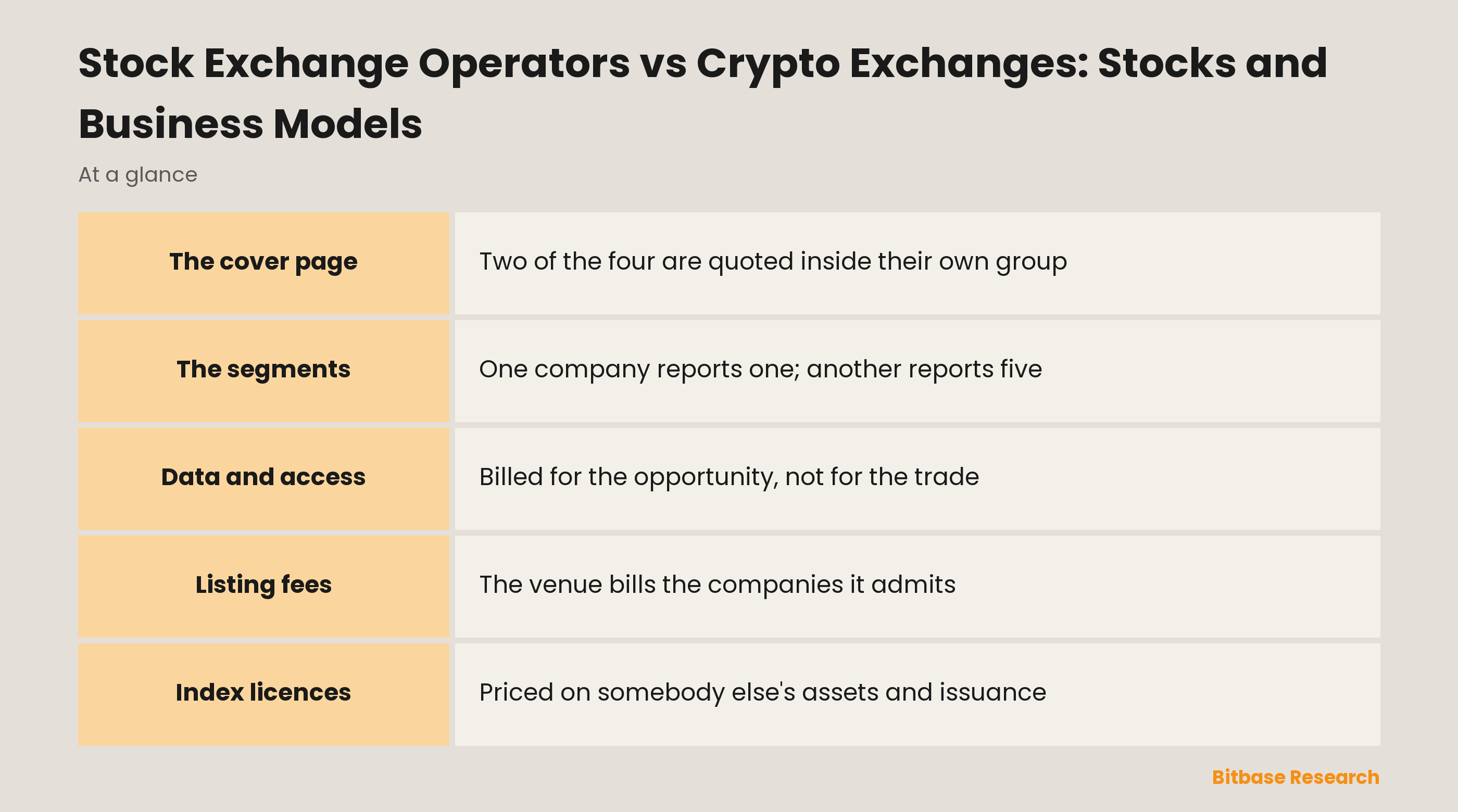
Two of those rows describe a company quoted inside its own group. Cboe's segment note places the exchanges "owned and operated by BZX, BYX, EDGX, and EDGA" in North American Equities, and Cboe BZX is where its own stock is registered. Nasdaq registers four series of senior notes on the same exchange as its common stock.
The Segment Maps Do Not Line Up
Comparing "the exchange business" across these four meets the reporting structure first. CME Group states that "the company's business is conducted through one reportable business segment, CME Group consolidated" — there is no exchange line to isolate. Cboe reports five: "Options, North American Equities, Europe and Asia Pacific, Futures, and Global FX". Nasdaq reports "Capital Access Platforms, Financial Technology and Market Services", of which one is a marketplace. Intercontinental Exchange shows the seam outright, describing "13 regulated exchanges and six clearing houses (one of which, ICE Clear Credit, is included in our Fixed Income and Data Services segment)". A clearing house the group owns is reported outside the segment called Exchanges.
So a figure lifted from one filing and set beside a figure from another usually measures different perimeters — a caution that reaches the listed crypto exchanges and brokers too.
What Gets Billed When Nobody Trades
Every venue is paid per trade; what separates these four is how much of the invoice does not depend on one.
CME Group names market data as "revenue from the dissemination of market data to subscribers, distributors, and other third-party licensees", and gathers into other revenue "access and communication fees, fees for collateral management, equity membership subscription fees, and fees for trade order routing". Cboe defines access and capacity fees as "fees assessed for the opportunity to trade" — the opportunity, billed whether or not it is taken. Intercontinental Exchange states the mix: "Revenues reflect a mix of both diversified transaction revenues and recurring data and listings revenues."
One Cboe line rewards a second reading. Regulatory fees include the options regulatory fee, "which supports the Company's regulatory oversight function", alongside other regulatory fees that "neither can be used for non-regulatory purposes". Money is collected, ring-fenced, and spent on policing the market it came from.
Listing Fees Run in the Other Direction
Nearly everything above is billed to people who want to trade. Listing revenue is billed to the companies being traded. Intercontinental Exchange states that its "listings revenues include original and annual listings fees, and other corporate action fees" — charged at admission, then again every year the company stays. Cboe books listing fees inside other revenue; Nasdaq carries Data and Listing Services inside Capital Access Platforms. Which is why the first table matters: for two of these registrants, the relationship between a listed company and the market admitting it is one the group has with itself.
An Index Is a Licence, Not a Product
The line furthest from any trade is the index. Nasdaq's business "develops and licenses Nasdaq-branded indices and financial products", and it states how that is priced: "License fees for our trademark licenses vary by product based on a percentage of underlying assets, dollar value of a product issuance, number of products or number of contracts traded."
Read those terms: a licence can be charged on assets somebody else gathered, on somebody else's issuance size, on how many products get built, or on contracts traded elsewhere. Cboe's market data fees likewise include "revenue from various licensing agreements". A licence is a contract before it is a revenue line, so it carries a counterparty, a term and a renewal — settled in negotiation, not on a screen.
Clearing Puts Something Between the Two Sides
CME Group bills clearing and transaction fees as "per-contract charges for trade matching, clearing, trading on the company's electronic trading platforms, portfolio reconciliation and compression services" — matching and clearing invoiced as one obligation. Cboe charges "transaction and clearing fees", and Intercontinental Exchange counts its clearing houses separately from its exchanges.
Whether a clearing house stands between the two sides of a trade changes the answer to who owes you, and that answer lives in a venue's rulebook. On the crypto side the question is worked through in counterparty risk on an exchange.
How to Check Any of This
Every sentence above sits at a fixed address. On EDGAR, CME Group files under CIK 1156375, Intercontinental Exchange under 1571949, Cboe under 1374310 and Nasdaq under 1120193. Item 1 names the segments; the revenue recognition note holds the wording about what each fee buys. Each filing also carries a structured version of its cover page, where the Section 12(b) fields are machine-filled values rather than prose — that is how the table above was checked.
None of this is a price, a multiple or a market share, so none of it goes stale between annual reports, which is the difference between a structural reading and a ranked list of names. Which instruments a venue offers on these companies is a question for that venue, and Bitbase keeps its lineup on the TradFi markets page.
The Bottom Line
An exchange operator sells four things at once: a match, a clearing service, a subscription, and a licence. The first two need somebody to trade. The other two are billed on a calendar, to people who may never place an order — data subscribers, firms paying to connect, companies paying to stay listed, issuers paying to use an index name. The comparison with a listed crypto exchange comes apart there.
Open the revenue note in each filing, read the category names rather than the totals, and see which categories exist in one document and have no counterpart in the other.
Related reading
Other Bitbase articles on this topic:
- Crypto Account Recovery Without the Old Phone Number
- Crypto Exchange Reserve Ratio: How to Read It, Coin by Coin
- The Crypto Listing Process
- What Is ATH (All-Time High)?
- Flags, Pennants, and Triangles
Disclaimer: This article is educational content from Bitbase Academy, provided for information only. It explains what a company or fund does and how the instruments referenced here differ from one another; it does not constitute investment, trading, tax, or financial advice, and it is neither a recommendation nor an endorsement of any security, token, or trading strategy. A tokenized stock is issued by a third party and is designed to give economic exposure to an underlying asset: it is not a share, it carries no shareholder rights, and it depends on the issuer's structure, eligibility rules, and redemption terms, which the issuer can change. Perpetual futures are leveraged derivatives that hold no underlying asset and can be liquidated, and trading hours, product availability, and eligibility differ by instrument and by jurisdiction and can change at any time. Written as of September 2026; verify everything yourself through company filings, the issuer's own documentation, and the product pages of the venue you trade on.
References
[1] CME Group Inc. annual report on Form 10-K for the year ended December 31, 2025 www.sec.gov
[2] Intercontinental Exchange, Inc. annual report on Form 10-K for the year ended December 31, 2025 www.sec.gov
[3] Cboe Global Markets, Inc. annual report on Form 10-K for the year ended December 31, 2025 www.sec.gov
[4] Nasdaq, Inc. annual report on Form 10-K for the year ended December 31, 2025 www.sec.gov