Rolling an index futures position is where the cost of holding futures over time stops being abstract. The contracts run out on a fixed quarterly calendar, they settle in cash against a price that is not a snapshot of anything visible on a screen, and moving from one contract month to the next is two trades rather than one. Commissions are the small part of that; the difference between the two prices is the number that decides what the roll cost.
When Index Futures Expire
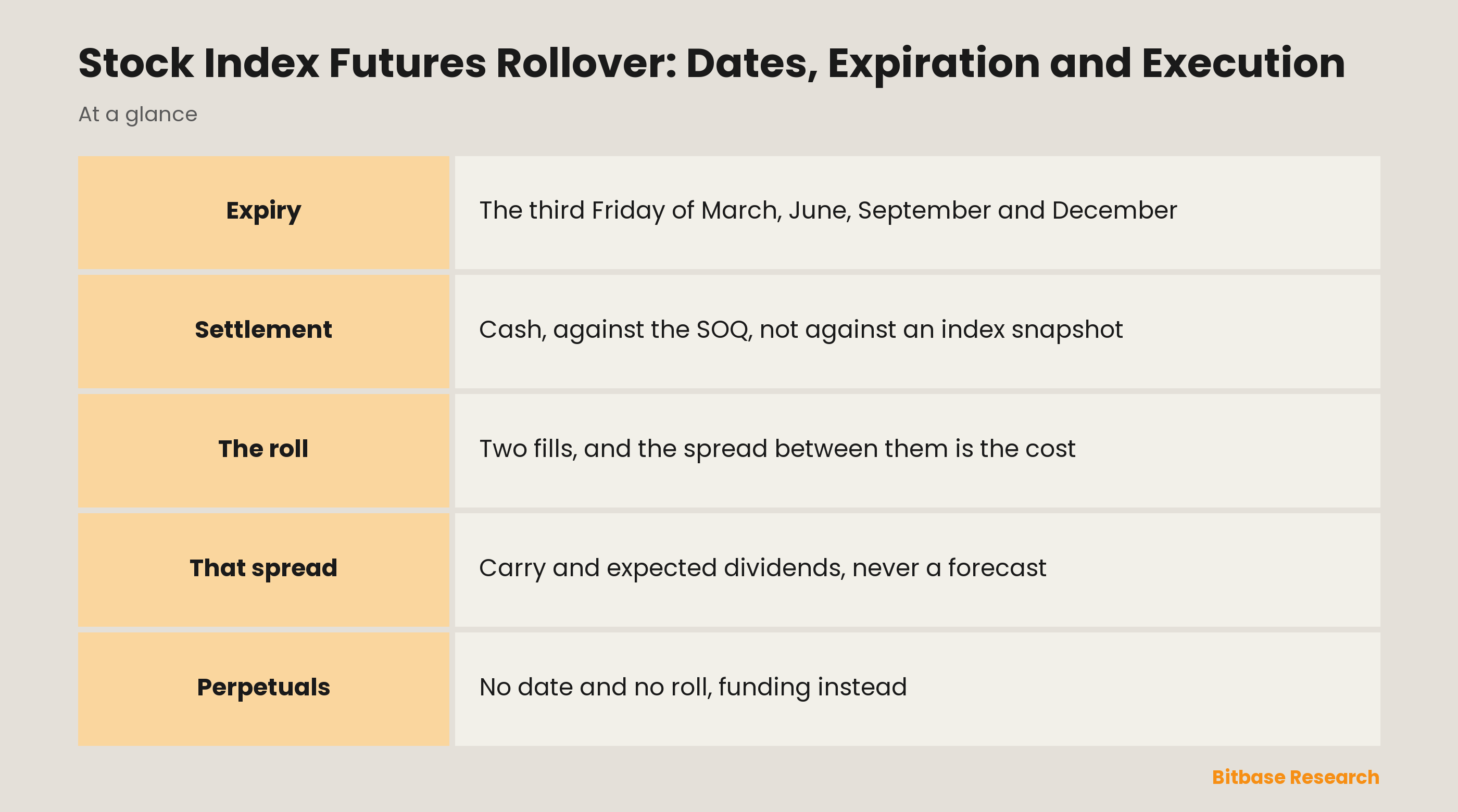
Stock index futures at CME run on a quarterly cycle: March, June, September and December. Each contract stops trading and expires on the third Friday of its contract month, which is why the calendar turns four times a year rather than monthly. The contract closest to expiry is the front month and normally carries most of the volume; the later ones are back months, listed and tradable but thinner.
Expiry is not the only date involved, because a futures position sits under three different calendars at once. The contract trades on CME Globex from Sunday evening at 18:00 ET to Friday afternoon at 17:00 ET, with a maintenance break every day between 17:00 and 18:00 ET. The stocks inside the index trade a much shorter exchange session, and the quarterly expiry follows neither clock. Day-to-day mechanics are covered in the guide to S&P 500 index futures; what follows is only about the part that ends.
What the Settlement Price Actually Is
Index futures are cash settled. No basket of shares changes hands at expiry, and an open position is simply converted into a cash amount. The number used for that conversion is the Special Opening Quotation, usually shortened to SOQ, which CME describes as being based on “the opening price of each component stock in the relative index, regardless of when those stocks open.”
The last clause of that sentence carries the rest of this article. Component stocks do not all open at the same instant, and on any given morning some of them open noticeably later than others. The SOQ is assembled out of each stock's own first print, whenever that print happens. The SOQ is therefore not the value of the index at any single moment in time, and it can differ from every index quote that prints that day, including the one on the screen when the opening bell goes.
Why Holding to Expiry Is Not the Same as Closing
Two ways out of an expiring contract look interchangeable on a position screen and are not. Closing it is an ordinary trade: a price appears, it is accepted or not, and the outcome is known when the fill comes back. Letting it expire hands the exit price to a mechanism instead. Closing is a price chosen; expiry is a price received, computed afterwards out of prints nobody watched in one place.
This is also where option positions arrive. An option that finishes in the money on the last trading day is exercised automatically into the expiring cash-settled future, so a holder who meant to trade options ends up settled against the same SOQ. Quarterly dates collect several kinds of expiry at once, which is part of why options expiry weeks behave unlike ordinary ones.
Executing a Roll: Two Trades, One Spread
A roll keeps the exposure and changes the contract carrying it. That means closing the position in the expiring month and opening the same position in a later month, which is two fills, not one adjustment.
| Choice | What happens on the date | What sets the exit price | Position afterwards |
|---|---|---|---|
| Close before expiry | The position ends early | The fill that is accepted | Flat, in cash |
| Hold to expiry | Cash settlement of the contract | The SOQ, known after the open | Flat, in cash |
| Roll to the next month | Two fills, one out and one in | Both fills, and the gap between them | Same exposure, one quarter later |
The fee on two fills is visible and small. The gap between them is neither. It is quoted in index points, and index points turn into money through the contract multiplier: the E-mini S&P 500 is $50 per index point and its micro version is $5; the E-mini Nasdaq-100 is $20 per point and its micro is $2. Both sizes move in the same minimum increment of 0.25 index points, so the micro is a tenth of the notional and a tenth of the tick value, not a different instrument.
Timing changes what those fills meet. Liquidity migrates from the expiring month into the next one over the sessions before expiry, so a position still sitting in the expiring contract late in that window leaves a book that has been emptying and enters one that filled up without it. Both legs are exposed to that. Volume and open interest per contract month are published by the exchange and describe the migration directly, which beats any fixed number of days.
Where the Calendar Spread Comes From
The later contract rarely trades at the same price as the expiring one, and the difference is not an opinion about direction. It is the cost of carrying index exposure across the extra quarter: financing on one side of the ledger, and the dividends the component stocks are expected to pay on the other. Those two pull the spread in opposite directions, and what is quoted is the net of them.
Crypto futures have the same structure with one leg missing, since there are no dividends to subtract; the resulting curve is described in basis, contango and backwardation. The consequence is identical in both markets. A calendar spread is a carry number, not a forecast, and reading a wider far month as a bullish signal mistakes arithmetic for sentiment.
The Chart and the Contract Are Not the Same Thing
Most charting platforms show a continuous series rather than a single contract, because one contract's history ends every quarter. That series is built by splicing months together, and every splice sits where a roll happened, between two prices that were never equal. Platforms either adjust the older data to remove the step or leave it in, and the two choices produce visibly different histories of the same market.
A continuous chart is a construction, not a contract. Levels read off it from before the last splice need not match any price that traded in the contract currently held, which matters for anything anchored to a specific number. The front-month chart is the honest one, at the price of stopping at expiry.
Perpetuals Do Not Roll
A perpetual futures contract has no expiry, so none of the above applies to it: no quarterly date, no SOQ, no second leg, no calendar spread to cross. That is the structural difference between it and a quarterly contract, and the reason a stock perpetual can be held indefinitely without any scheduled event.
The carry does not disappear, it changes shape. A quarterly contract charges it once per roll in a spread; a perpetual charges it continuously through funding, a periodic transfer between the long and short sides. Neither structure is free, and the useful comparison is not which is cheaper in the abstract but which shape of cost matches the length of time the position is meant to be held.
The Bottom Line
Rollover is usually described as housekeeping, and that description hides the two places where money moves: the spread paid to change months, and the settlement price that arrives instead of a chosen exit. Both follow from one design decision, that these contracts end on a date and settle against the component stocks rather than against the index print. Multipliers, tick sizes, hours and the settlement rule quoted above all come from the CME contract specification pages, the authority for whichever contract is being traded.
Related reading
Other Bitbase articles on this topic:
- ES vs MES Futures: Contract Size, Margin, Trading Hours and Rollover
- FOMC and Equity Derivatives: Volatility, Execution and Position Risk
- NQ vs MNQ Futures: Contract Size, Margin, Trading Hours and Rollover
- What Are Crypto Options? Calls, Puts, Strikes and Expiry
- What Is Crypto Wallet Encryption? How Your Keys Stay Safe
Disclaimer: This article is educational content from Bitbase Academy, provided for information only. It explains what a company or fund does and how the instruments referenced here differ from one another; it does not constitute investment, trading, tax, or financial advice, and it is neither a recommendation nor an endorsement of any security, token, or trading strategy. A tokenized stock is issued by a third party and is designed to give economic exposure to an underlying asset: it is not a share, it carries no shareholder rights, and it depends on the issuer's structure, eligibility rules, and redemption terms, which the issuer can change. Perpetual futures are leveraged derivatives that hold no underlying asset and can be liquidated, and trading hours, product availability, and eligibility differ by instrument and by jurisdiction and can change at any time. Written as of September 2026; verify everything yourself through company filings, the issuer's own documentation, and the product pages of the venue you trade on.
References
[1] CME Micro E-mini Nasdaq-100 contract specifications: multiplier, tick size, trading hours and quarterly cycle www.cmegroup.com
[2] CME Micro E-mini S&P 500: contract size, third-Friday expiration and cash settlement against the Special Opening Quotation www.cmegroup.com