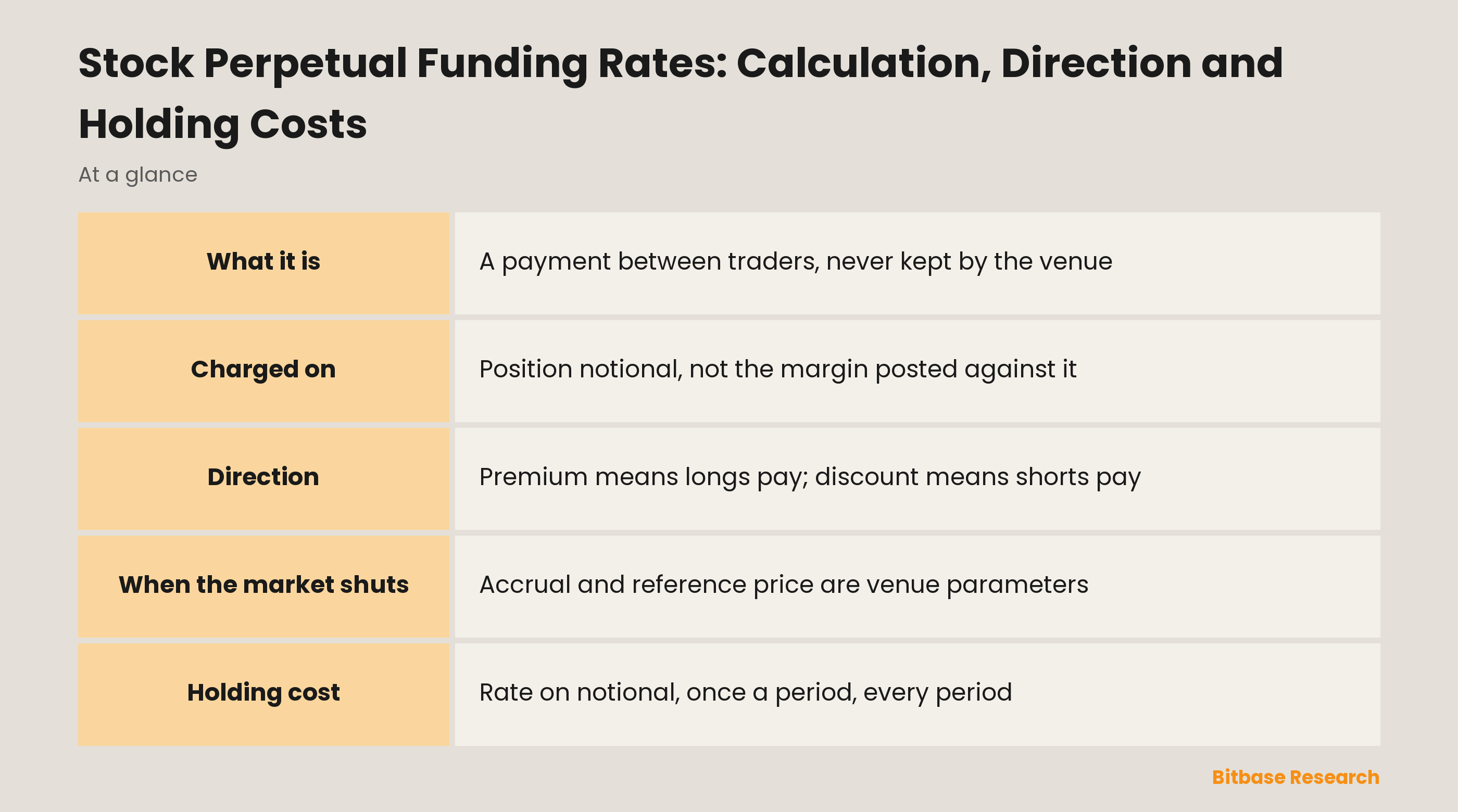
You never pay funding to the exchange. You pay it to the traders on the other side of the contract, or they pay it to you, and which way it moves is settled by where the perpetual trades against the share it tracks. The payment repeats every period the position stays open, which turns holding time into a line item — and on a stock perpetual, the market that supplies the reference closes every night.
What the Payment Is Charged On
Funding is a recurring transfer between the long and short sides of the same contract. The stock perpetual guide sets out why the mechanism exists: a contract with no settlement date has nothing pulling it back toward the underlying, so the payment does that work instead. What follows is the part that decides what the position costs to hold.
Start with the base, because the rest follows from it. Funding is calculated on the notional value of the position — size multiplied by price — not on the margin posted against it. Two accounts holding identical exposure owe identical funding, even if one put up a tenth of the collateral the other did.
Three consequences drop out of that. Leverage does not raise the funding bill; it shrinks the account the bill is charged to, so the same payment becomes a far larger share of the margin at risk. The venue's trading commission is a separate charge on top, paid to the venue rather than to another trader. And a position can be flat on price and still down on the account, because the payment keeps landing whether the price moved or not. The mechanics carry over intact from the crypto funding rate; the base and the direction are what change the bill.
Which Way It Flows
Direction is not chosen by a schedule or by the venue's opinion. It comes from the contract's own price measured against its reference.
| Rate sign | Where the perpetual trades | Who pays whom | What it describes |
|---|---|---|---|
| Positive | At a premium to the reference | Longs pay shorts | Demand to be long outweighs the short side |
| Negative | At a discount to the reference | Shorts pay longs | The short side is the crowded one |
| Near zero | In line with the reference | Almost nothing changes hands | The two sides are close to balanced |
Read the sign as a description of positioning, never as an instruction. A positive rate says the long side is currently paying to stay long. It says nothing about where the share goes next, and crowded positioning can stay crowded for weeks. What it does report precisely is which side is subsidising the other, and therefore whether your own cost base grows or shrinks while you wait.
Why the Rate Moves
The payment is corrective by construction. When a perpetual trades above its reference, charging the long side makes that side more expensive to hold, and that expense is what narrows the gap. Below the reference, the incentive runs the other way. The wider the gap, the harder the mechanism has to push — which is why the rate is not a constant but a figure re-struck each period from conditions that have just changed.
The arithmetic itself — how often funding settles, the formula that converts a premium into a rate, the bounds that keep one period from running away — is a venue parameter, not a property of the instrument. Two platforms listing a perpetual on the same share can settle on different schedules and arrive at different figures. Read the contract rules page of the platform you trade on. Nothing else is authoritative, and it can change.
What Happens When the Share Market Closes
This is where the stock version parts company with the crypto one, and the difference is not leverage, size or fees. It is the calendar sitting underneath the reference.
A crypto perpetual references a spot market that never shuts: there is always a fresh print to build a reference from, and the interval between observations is measured in seconds. A stock perpetual references a market that closes every weekday evening, stays closed all weekend, and closes again for holidays. Through those hours the underlying produces no new trades at all — not thin ones, none.
Two questions therefore become real here that never arise on a crypto perpetual. What is the reference built from while the reference market is shut? And does funding accrue through those hours, or pause?
Both are venue parameters, and both belong on the contract rules page. Find them before the first weekend rather than after it, because the two possible answers are not symmetrical. If accrual continues through a closure, a weekend is several periods of cost on a position whose underlying cannot move. If it pauses, the cost resumes at the reopening, against a price that may have gapped. Either way the mark price keeps running, so a position can still be closed out while the exchange the share lists on is dark.
How the Bill Adds Up
The cost of holding is the sum, across every period the position stayed open, of that period's rate applied to that period's notional. Three inputs, and only one of them is yours to set.
Notional is chosen at entry and then drifts with the price. The rate is re-struck each period and is not knowable in advance. The number of periods is simply how long you stayed. So the total is not a quote obtainable at entry — it is an accumulation, and the only part under direct control is size.
Two properties follow. The cost grows with holding time rather than with trade count, which inverts the intuition most people bring across from shares. And it does not stop when the price does: a position that has gone nowhere for a month has still been paying, or collecting, the whole time. The worked arithmetic is in what it costs to hold a perpetual, and the way those payments land in the account rather than in unrealised price movement is in funding payments and perpetual profit and loss.
One Exposure, Three Cost Shapes
| Instrument | When the carrying cost is charged | What it scales with | What ends it |
|---|---|---|---|
| Share held outright | At entry and at exit only | The trade, not the holding period | Selling the share |
| Stock perpetual | Every funding period | Notional, rate and elapsed time | Closing the position |
| Micro index future | Once per roll | The spread between two contract months | Expiry, or rolling forward |
The middle row is the one carried across from the top row badly. Buying a share outright costs a commission twice and, unless the position is financed, nothing in between, so holding it for a year is, in carrying terms, much the same as holding it for a day. A perpetual reverses that shape: entering is cheap and staying is not.
The bottom row is different again. Micro index futures carry no funding at all. They run on a quarterly cycle and settle in cash on the third Friday of March, June, September and December, so anyone wanting continuous exposure pays at the roll instead — once a quarter, as the price difference between the expiring contract and the next. Same economic idea, arriving as a lump rather than a stream.
What to Check Before the First Overnight
Four items on the venue's rules page decide what a position actually costs, and none can be inferred from a crypto contract. The settlement interval: how often the payment is taken. The formula and its bounds, including any limit on how extreme a single period may get. The closure treatment: what happens to the reference price and to accrual while the underlying market is shut. And the booking — realised into the balance, or charged against position margin, which decides whether funding alone can reach a liquidation.
The Bottom Line
Funding is a transfer between traders, charged on notional, its direction set by whether the contract trades above or below the market it tracks. It accumulates with time rather than with activity, which makes intended holding period a sizing input rather than an afterthought. The piece genuinely specific to shares is the closure window — and it is also the piece no guide can answer for you: the interval, the formula, the bounds and the closure treatment all live on the contract rules page of the venue being traded, and they change.
Related reading
Other Bitbase articles on this topic:
- ES vs MES Futures: Contract Size, Margin, Trading Hours and Rollover
- FOMC and Equity Derivatives: Volatility, Execution and Position Risk
- NQ vs MNQ Futures: Contract Size, Margin, Trading Hours and Rollover
- What Is Wrapped Crypto?
- How Prediction Markets Settle
Disclaimer: This article is educational content from Bitbase Academy, provided for information only. It explains what a company or fund does and how the instruments referenced here differ from one another; it does not constitute investment, trading, tax, or financial advice, and it is neither a recommendation nor an endorsement of any security, token, or trading strategy. A tokenized stock is issued by a third party and is designed to give economic exposure to an underlying asset: it is not a share, it carries no shareholder rights, and it depends on the issuer's structure, eligibility rules, and redemption terms, which the issuer can change. Perpetual futures are leveraged derivatives that hold no underlying asset and can be liquidated, and trading hours, product availability, and eligibility differ by instrument and by jurisdiction and can change at any time. Written as of September 2026; verify everything yourself through company filings, the issuer's own documentation, and the product pages of the venue you trade on.
References
[1] CME Micro E-mini Nasdaq-100 contract specifications: quarterly cycle, third Friday expiry and cash settlement www.cmegroup.com
[2] CME Micro E-mini S&P 500: quarterly cash settlement and the roll between contract months www.cmegroup.com